
A parking facility is not real estate with a gate; it is a 24/7 point of sale whose every transaction — a plate read at the ramp, a barrier lift, a pay-by-plate settlement — depends on a network most operators never see. The failure is rarely the camera or the boom. It is the node that has to keep the lens powered, the inference running, the plate data local, and the gate answering where no one is on shift. This is a field guide to that node: the industrial cellular router with PoE++ camera power, 5G dual-SIM failover, edge-AI license-plate recognition and payment-grade security that turns a concrete deck into a trusted, always-open transaction edge.
Written by E-Lins Engineering Team
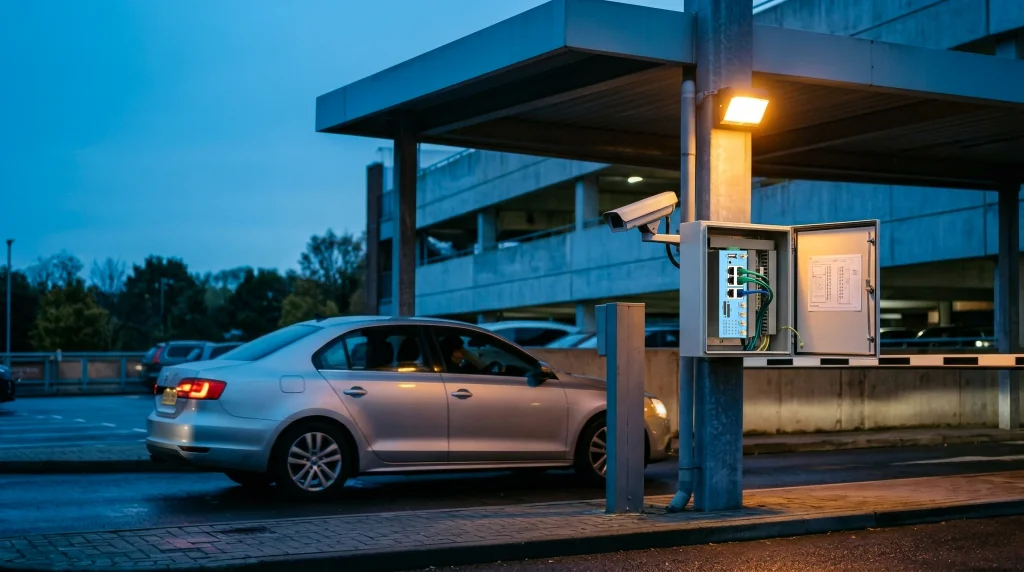
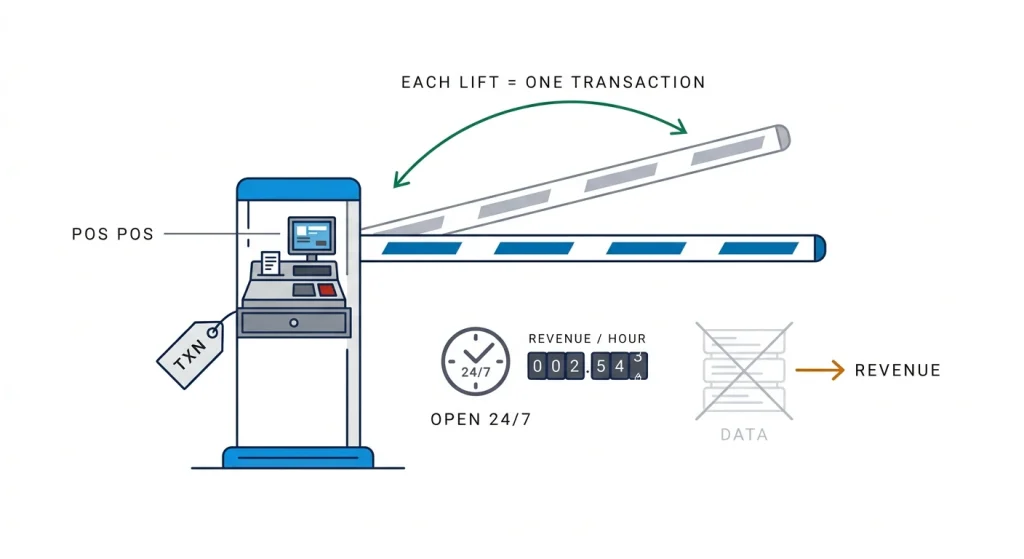
The Lot Is a Point of Sale
There is a comfortable assumption behind most “smart parking” projects: that once you install a few cameras, a barrier and a pay station, you have a smart lot. You have hardware. The intelligence and the revenue only exist when the connection between the lens, the inference, the payment switch and the cloud holds — continuously, at three in the morning, in a concrete canyon with one bar of signal, while the only person on site is the driver waiting for the boom to rise. A parking asset monetises throughput in real time, which is precisely what makes its network different from a warehouse or a wind farm: every dropped plate read is a car that has to be waved through, manually validated, or billed by hand.
For a city garage turning over four thousand vehicles a day, a ten-minute network dropout at the exit during the evening peak is not an IT incident. It is a queue, a stack of lost ticket validations, a chargeback risk, and a one-star review on the parking app — multiplied across every lot in the portfolio that week. The gate is the till. When the till stops answering, the lot does not stop being a business; it stops being able to collect, and the cost shows up on the same ledger the technology was meant to improve.
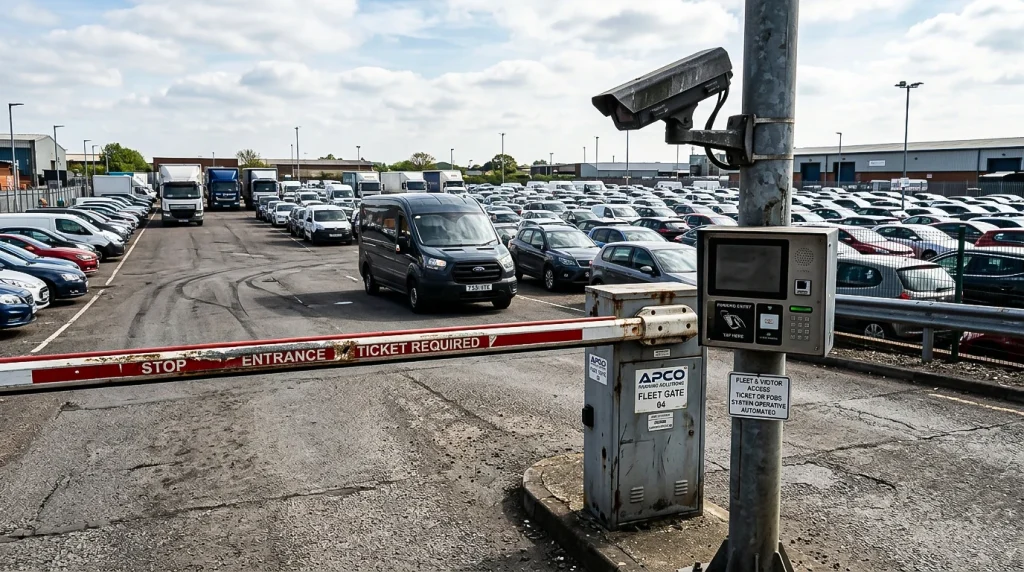
The uncomfortable premise of parking networking is that the places a lot most needs connectivity are the places least equipped for it: the exposed entry canopy with no cabinet, the underground deck with no reception, the decade-old pay station whose serial port predates the cloud. A plan that assumes a powered cabinet and a clean signal works in the demonstration and fails at the ramp. Treating the node as an engineering problem in its own right — not as a cable to a router in the operator’s office — is the difference between a lot that is smart and a lot that merely has cameras.
| The node is the transaction system. At the curb the router is not a peripheral that connects the camera to the internet. It is the power feed to the lens, the bridge to the barrier’s serial line, the store-and-forward buffer for a plate read, the local inference host or its secure transport, the VPN to the payment switch, and the locator that tells the back office which gate just opened. Get the node wrong and the most advanced ANPR engine in the world produces a car that could not get in. |
Anatomy of the Connected Lot
A modern parking facility is a small network of networks, and most of it was never designed as one. At the minimum there is an ANPR or LPR camera at every entry and exit; a barrier or boom controller; a pay-on-foot station and, increasingly, a pay-by-plate settlement path that never touches a ticket; an occupancy layer of magnetometers, ultrasonic or infrared sensors and in-ground loops; variable-message signage for guidance; an EV charger bank that has quietly become part of the same site; and a back office or cloud where sessions, accounts and enforcement live. Each of those touches the network with a different protocol, a different power need and a different tolerance for latency, and the lot only works when all of them work at once.
| Failure mode | What it looks like | What actually broke |
|---|---|---|
| Camera power loss | ANPR blind at entry; manual gate, lost validation | No PoE budget at the pole; AC circuit absent or failed |
| Connectivity loss | Plate read cannot reach payment switch; gate stuck or forced open | No or poor coverage underground; single carrier down |
| Inference stall | Cannot match plate to session; pay-by-plate fails | ANPR engine wedged; cloud link dead; no fail-open logic |
| Bandwidth cost | Full video stream unaffordable | Raw frames priced out over cellular backhaul |
| Legacy island | Old barrier or loop not under central control | RS-485 instrument with no protocol gateway |
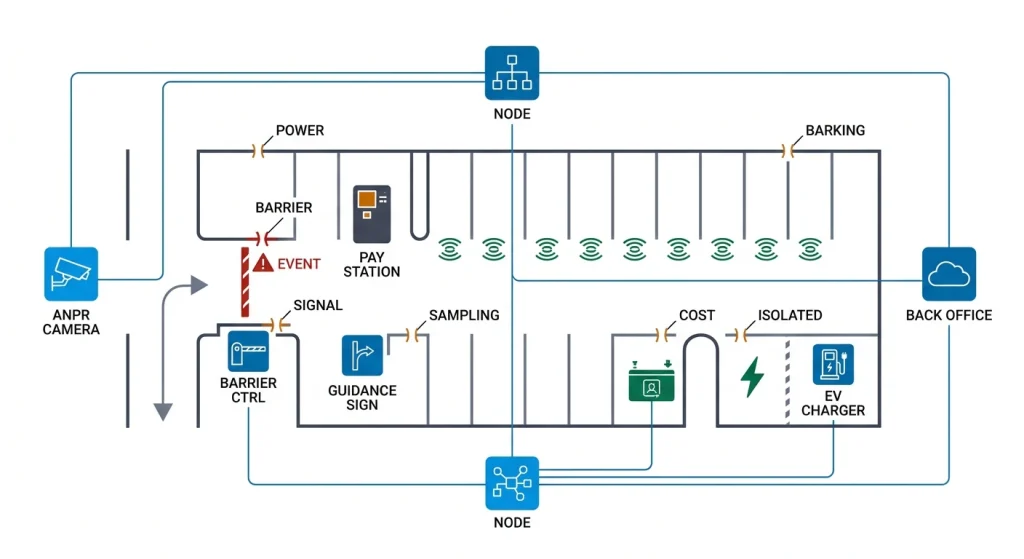
Read that table against the usual procurement habit and the pattern is familiar from every other edge deployment: most designs protect against one of these and quietly assume the others will not happen — a PoE switch, so camera power is “handled”, until the switch has no redundant supply; a single SIM, so connectivity is “handled”, until both carriers share the tower the underground deck was built around. A parking network is only as complete as its least-covered failure mode.
Two modes deserve separate attention because operators underestimate them. The first is the inference stall: the “smart” part of a smart lot is the recognition that opens the gate and settles the charge, and when it stalls the lot reverts to a manually operated car park with none of the labour it was designed to remove. The second is the legacy island: the barrier that has lifted a million cars is usually the one still speaking RS-485 to nobody, and a network that cannot see it cannot control the single mechanical thing that lets a car in or out.
Intelligence at the Curb: Edge AI for License Plates
The entire point of a smart lot is recognising a plate and acting on it — open the gate for a monthly, charge the right account, enforce an overstay, flag a banned plate. That is automatic number-plate recognition, and ANPR is an edge-AI workload by nature: you cannot ship every camera frame to a distant data centre and expect a sub-second boom. The recognition has to happen where the car is, and the network’s job is to make that possible, affordable and private — not to run the model itself.
What the node contributes to an ANPR pipeline is where this article’s hero capability lives:
- Power the camera. An ANPR lens is useless without power, and the same node that carries the result also feeds the lens — over PoE++, as covered in the power section. No lens, no recognition, no transaction.
- Carry the inference. Either on a companion edge-AI box hung off Gigabit Ethernet (the H700’s five switchable GbE ports are built for exactly this), or as on-router rules for the simple decisions a lot makes thousands of times a day.
- Keep plate PII local. The read happens at the curb; only the match result or an exception travels to the cloud. That is privacy by architecture and bandwidth sanity at once.
- Fail open. A wedged inference engine or a dead cloud link must not hard-stop the gate. A local cache of valid plates and a fail-open rule keep the lot moving when the smart part briefly is not.
- Router-level rules. A node such as the H750, with DI/DO and Modbus/DTU, can run threshold alarming and aggregation on the device itself — count entries, flag a plate never seen on entry, alert on a tailgater — with no companion computer, which is enough for most enforcement logic.
- Companion edge AI. Where genuine plate inference is needed, a purpose-built edge compute device does the model, and the H700 (Gigabit Ethernet) or H900 (PoE, VPN-secured update path) is the connectivity layer around it — not the accelerator itself.
- GNSS location. A node that reports its own position — as the H720 and M400 do with GNSS — turns a reading into a placed event and makes a relocated mobile-enforcement unit self-identifying the moment it powers up.
| Be honest about what “edge AI” means here. None of these platforms includes a dedicated GPU or NPU accelerator; genuine ML inference is performed by a purpose-built edge device the router connects and secures. The router’s job is reliable, secure transport and on-device rules — the connectivity judgement, not the inference. Specifying a router as if it runs the model is the mistake that inflates cost and under-delivers detection. |
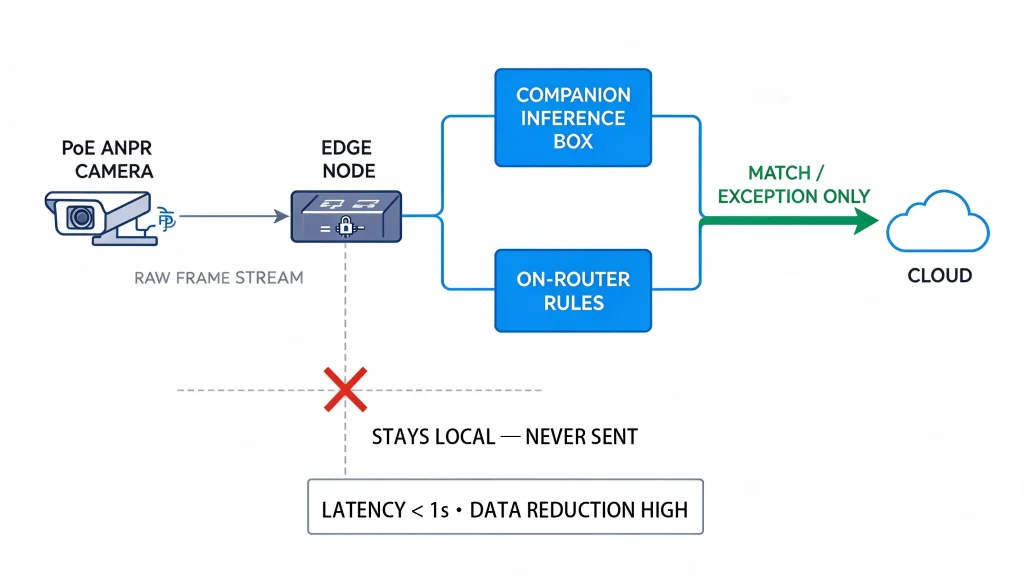
The value metric at the curb is the data-reduction ratio and the decision latency, not the buzzword. A lot that sends the match rather than the stream can afford higher camera frame rates and still keep the backhaul cheap, and the gate answers in the time a driver expects — which is how plate recognition becomes dependable enough to trust with revenue, across a whole city’s kerb.
Power and Environmental Resilience: Keeping the Gate Online
A parking router must operate in conditions that are far less predictable than a typical office network. It may be installed inside an enclosed underground deck, beneath an exposed entry canopy or in a roadside cabinet, where heat, dust, moisture and unstable power can affect continuous operation.
The first requirement is choosing hardware suited to the installation environment. For exposed entry and exit points without a protective cabinet, an IP68-rated outdoor cellular router such as the E-Lins H820QO offers a suitable deployment option. For sheltered cabinets, an IP30 metal-case router may be sufficient. Temperature ratings, enclosure protection and mounting options should always match the actual site conditions.
Power design is equally important. A camera losing power means ANPR stops working; a router losing power can disconnect the camera, barrier controller and remote management system at once. Several capabilities help reduce this risk:
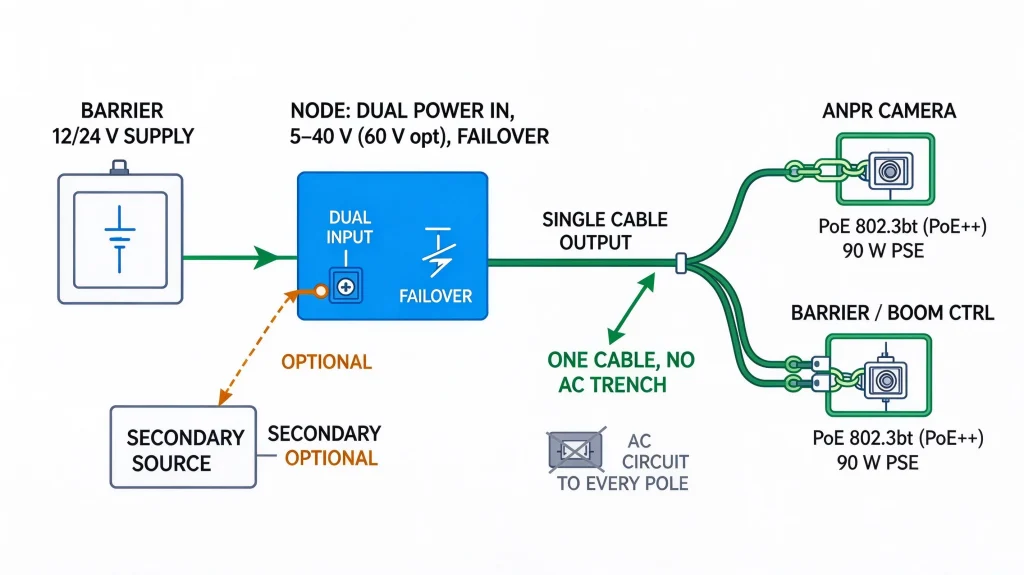
- Wide-voltage input: Depending on the model, 5–40 V DC input, with a 5–60 V DC option, supports common 12 V or 24 V site power systems.
- Dual power inputs: Selected models support two power inputs with failover, helping maintain operation if one supply fails.
- Transient protection: ISO 7637-2 protection helps the device withstand specified electrical transients on the power supply.
- PoE++ camera power: The E-Lins H900f and H900pf support PoE PSE under IEEE 802.3bt, allowing compatible ANPR cameras and other powered equipment to receive both data and power through Ethernet.
For example, at a surface parking entrance, an H900-class router can connect an ANPR camera over PoE++, while its DC inputs connect to the site’s available power sources. This reduces separate cabling requirements and simplifies installation at locations where running an additional AC circuit is difficult.
The key is to size the power supply for the router and connected equipment, verify the PoE power budget, and confirm the exact input and environmental specifications for the selected model. A reliable parking node is not simply one that connects to the network; it must remain powered and operational throughout the conditions it was installed to handle.
| Field pattern A surface-lot entry pairs an H900pf at the canopy with a single PoE++ cable to the ANPR camera and the boom controller, dual 12 V/24 V feeds into its two power inputs, and dual SIMs for the link. One node, one cable to the lens, a gate that fails open on loss of cloud, and no electrician’s trench across the apron — exactly the deployment the H900-class and H820QO datasheets describe for exposed, cabinet-free stations. |
Connectivity: The Gate Can’t Wait
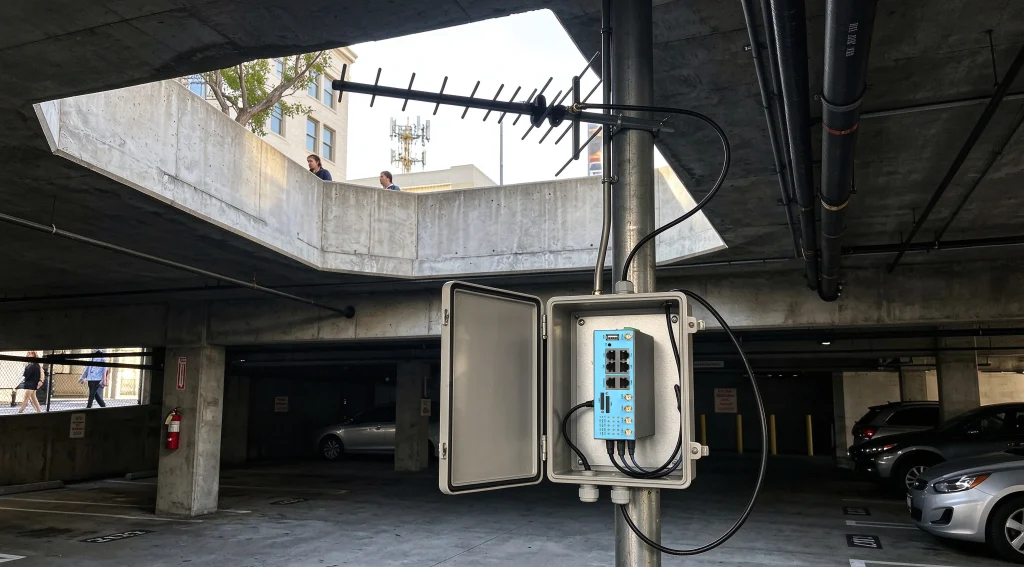
Parking lives in radio-frequency nightmares. Underground decks are effectively shielded rooms; concrete canyons between towers turn signal into multipath mush; old buildings swallow the band a decade-old modem expected. That is precisely where a single carrier is a single point of failure, and where the choice between internal and external antennas stops being cosmetic.
- Two carriers, two SIMs online. Where traffic can use two mobile networks, one operator’s failure no longer takes the exit with it; per-SIM configuration and SIM-based auto-carrier selection let one device carry that intent. On dual-module models such as the H900f and H900pf, two SIMs stay online at once.
- Two media where they exist. A lot with any fixed path — a building feed, a wired backhaul to the operator’s network, a Metro Wi-Fi link — should fail over between cellular and that path rather than betting everything on the air interface, using Wi-Fi as WAN and Ethernet WAN alongside the cellular link.
- Coverage at the edge. Internal high-gain antennas cover the easy cases; connectors for an external high-gain antenna let the same platform reach the deck in the dead spot, mounted where the signal actually is.
- Failover is a detection problem. A device cannot fail over from a path it believes is healthy, so what matters is deciding a link is dead even when the radio still reports a session: link supervision and a watchdog that recovers a wedged node.
| SMS is the channel of last resort, and it should be standard. Short Message Service runs on the cellular signalling plane rather than a data session, so it can be delivered when no data connection can be established — VPN down, platform unreachable, or the SIM’s allowance exhausted — and lands on the on-call phone at three in the morning. A parking node should support SMS control, gateway and alarm as standard, so every deployed gate carries the out-of-band path by construction; a node that can be commanded by SMS when nothing else works can be recovered without sending a person to the ramp. |
Talking to the Lot
Most parking equipment in the field today was never designed to speak IP. The barrier speaks Modbus over RS-485 or pulses on a loop detector; the occupancy layer is magnetometers, ultrasonics and in-ground loops; the cameras are IP; the signage is serial or IP; the EV chargers are their own conversation. The node’s job is to be the protocol bridge that makes all of them first-class citizens of one network — with addresses, polling and alarm thresholds — rather than a box of loose wires.
- Serial to cloud. A node with RS-232 and RS-485 and a built-in DTU brings legacy barriers, loop detectors and occupancy counters online without replacing them, polling each drop on its address and forwarding state over the cellular link. The compact E-Lins M400 modem is built for exactly this — a cellular modem with RS-232 / RS-485 / USB / RJ-45 and GNSS, suited to the sensor-side of a lot where an old instrument still does the lifting.
- Discrete and analogue I/O. DI/DO ×4 on the metal-case nodes lets the gate act on the physical world: read a barrier contact, drive a local alarm, or command a relay, so the node is a controller as well as a gateway.
- Powering the new instruments. Modern IP cameras and smart sensors want PoE. A node with PoE PSE — the H900f and H900pf add 802.3bt (PoE++) — runs a camera or a powered sensor on a single cable, which is what turns a bare gate into a visible, verifiable entry post.
| Field pattern A parking deck where an old RS-485 barrier and a new PoE ANPR camera coexist on one H900-class node: the node polls the barrier for state, powers the camera, caches plate reads through a coverage gap, and stores-and-forwards the session when the link returns. No forklift upgrade, no second vendor — the heterogeneous lot becomes one network. |
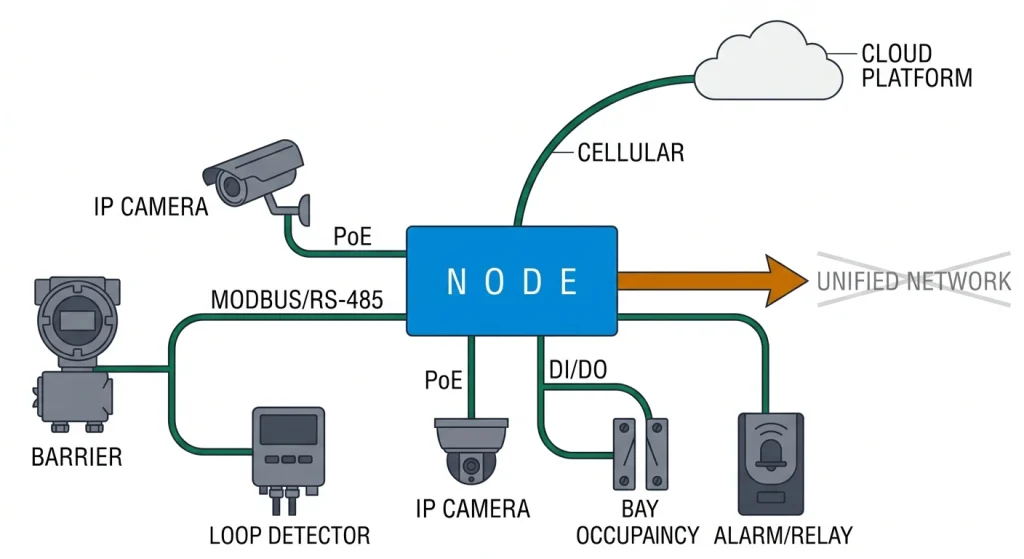
The point is continuity of interface as well as data. A parking programme that can absorb a new PoE camera, an old RS-485 boom and an ultrasonic bay sensor without a rip-and-replace survives contact with the real, layered structure — where last year’s barrier and this year’s recognition engine coexist on the same gate.
Securing the Exposed Node
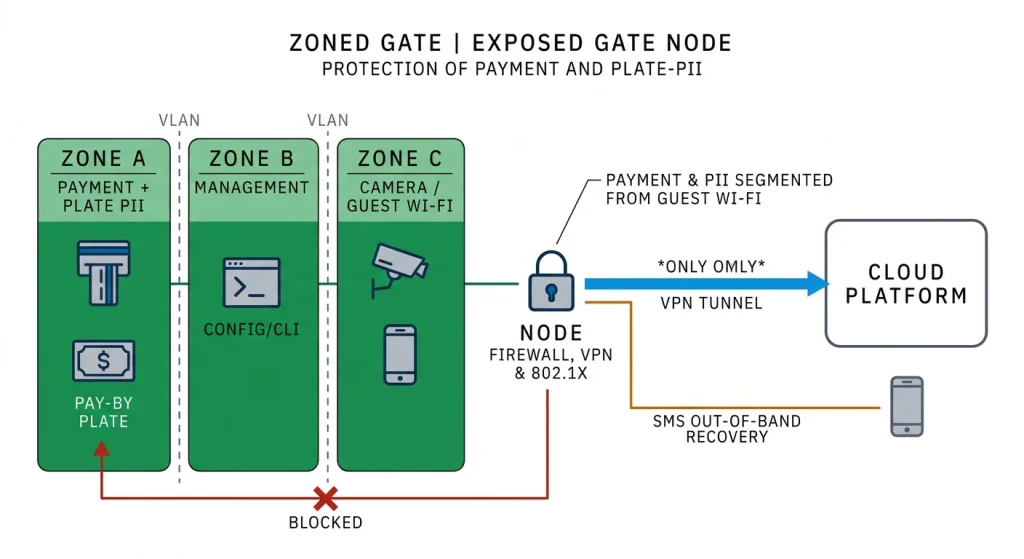
A parking node carries two categories of sensitive data over the public internet — payment information at the pay station and pay-by-plate path, and license-plate identifiers that are, in most jurisdictions, personal data in their own right. It sits in a place physically reachable by thousands of strangers a day, and reachable over the air by anyone with a radio. The moment it is on the internet, the familiar questions apply: can someone see what it is doing, change it, or stop it entirely. The right mental model is the one that governs any payment system — the cellular connection is a controlled crossing between zones, not a door left open.
- Tunnel and identity. VPN, firewall, 802.1X, RADIUS and TACACS+ put the device behind authenticated access rather than on the open internet, so the field node is the sensible place to apply most of the exposure control.
- Segmentation. VLAN 802.1Q separates the payment LAN, the camera and signage traffic, and any guest or operator Wi-Fi on the single uplink, so a compromised camera cannot reach the payment switch or the back office.
- Minimise and localise the PII. Because the plate read stays at the curb (per the edge-AI section), only match results and exceptions leave the gate — which shrinks the privacy surface by design rather than by policy.
- Secure the recovery channel too. SMS command recovers a node when the data path is dead, so access to it must be controlled as seriously as the primary VPN — a recovery mechanism anyone can invoke is a denial-of-service mechanism with a friendly name.
| Secure by default, not by intention. The hazard in parking is the network’s own haste — a default password left in place on a pay station, a management port exposed on the wrong interface, a profile copied from another lot with its credentials intact. A node whose management is designed for the field turns “we will secure it later” into “it is secure by default”. |
A City of Lots, Not One
A parking operator rarely owns one gate but a portfolio — street-surface lots, deck structures, airport aprons, hospital visitor bays, enforcement vehicles — that may have to come into service at once, in different places, with peak season already running. At that scale the deciding factor is not the individual device but whether the fleet can be deployed, diagnosed and maintained without an engineer at every site, every week.
- Zero-touch provisioning. A node that contacts a central platform on first power-up, identifies itself and receives a role-based configuration can be brought into service without a hand-build: it reaches the platform via a bootstrap path before its firewall and VPN rules apply, the platform identifies it reliably so a swapped spare inherits the right role, and the configuration is templatable so many deployments come from one definition.
- Fleet management. Cloud fleet management with status and alerting, SNMP and TR-069 where existing tools expect them, remote profiles, template deployment and backup/restore, a web GUI and CLI over SSH for diagnosis without a dispatch, SMS control to recover an unreachable node, data-usage alerts at router and per-client level, and over-the-air firmware update.
- Readiness routines. A pre-deployment health check (firmware, profile, SIM state, last-known link quality) before a node leaves the store; a profile library per role (surface lot, deck gate, enforcement vehicle); and a documented power budget per type, so the operator knows how long each gate stays reachable after the supply flickers.
| Standardisation is the capability. A handful of nodes sharing a family, a platform and a provisioning method is a parking network an organisation can stand up at short notice; a cabinet of bespoke devices, each with its own manual, is a liability with a networking problem attached. The fleet is observable only if the platform makes it so. |
What to Spec: A Smart-Parking-Node Checklist
This section turns the reasoning above into a specification checklist, each item tied to the field problem it solves, and every entry is a documented E-Lins capability drawn from the datasheets.
- Survive the site. IP68 where there is no cabinet (H820QO), IP30 metal where there is; −35 to +75 °C; ISO 7637-2 transient protection.
- Run off anything. 5–40 V DC (5–60 V option) wide input, dual power inputs with failover, stated idle/typical/peak current for supply sizing.
- Power the lens. PoE PSE 802.3bt (PoE++) on the H900f / H900pf to feed an ANPR camera and a barrier on one cable; PoE PD on the H685f, H720, H750 and H700.
- Reach the gate. Dual SIM or dual-module multi-carrier failover (two SIMs online on H900f/H900pf); external-antenna connectors; Wi-Fi as WAN and Ethernet WAN; SMS control, gateway and alarm as standard.
- Speak to the lot. RS-232 / RS-485 with Modbus and DTU; DI/DO ×4; Gigabit Ethernet (H700 ×5) to a companion edge-AI box; GNSS for placed events (H720, M400).
- Stay secure and manageable. VPN, firewall, 802.1X, RADIUS/TACACS+, VLAN 802.1Q; zero-touch provisioning; NMS, TR-069 and SNMP; OTA firmware.
Choosing the node: E-Lins industrial cellular router for a smart parking deployment
The checklist says what a parking node must do; this table says which E-Lins models do it, and where each belongs in a lot. Every line is drawn from the published datasheets — the same wide 5–40 V DC (5–60 V option) input, dual power inputs with failover, ISO 7637-2 protection, serial Modbus and DTU, SMS alarm and control and NMS management appear across the family (DI/DO ×4 and RS232/RS485 are present on the metal-case models), so the real differences are enclosure, cellular generation, SIM architecture, PoE role and compute role.
| Model | Cellular | Enclosure & mounting | I/O for the lot | SIM & failover | Power & PoE | Best-fit role |
|---|---|---|---|---|---|---|
| H900f | 5G SA+NSA | IP30 metal; DIN, wall, desktop | DI/DO ×4; RS232/RS485 | Dual-module, two SIMs online | 5–40 V DC dual-input; PoE PD/PSE af/at/bt | 5G gate hub powering ANPR camera + barrier over PoE++ |
| H820QO | 4G LTE | IP68 outdoor; pole, wall, DIN, desktop | Serial (Modbus, DTU); SMS alarm & control | Dual SIM online | 5–40 V DC (5–60 V opt); PoE PD | Exposed entry/exit canopy station, no cabinet |
| H685f | 5G, compact | IP30 metal; DIN, wall, desktop | DI/DO ×4; RS232/RS485 | Single SIM | 5–40 V DC dual-input; PoE PD af/at/bt | Cost-effective per-gate node, powered via PoE |
| H720 | 4G LTE | IP30 metal; DIN, wall, desktop | DI/DO ×4; RS232/RS485 | Dual SIM online | 5–40 V DC dual-input; PoE PD; GNSS | Curbside / mobile-enforcement lot, GNSS-tagged |
| H750 | 3G/4G LTE | IP30 metal; DIN, wall, desktop | DI/DO; Modbus / DTU | Dual SIM online; link bonding | 5–40 V DC dual-input; PoE PD | Secure payment hub; on-router ANPR event rules |
| H700 | 3G/4G LTE, GbE ×5 | IP30 metal; DIN, wall, desktop | Gigabit Ethernet to companion AI; DI/DO, RS232/RS485 | Dual SIM online | 5–40 V DC dual-input; PoE PD | Connectivity layer for an edge-AI ANPR box |
| M400 | 4G/3G/2G modem | Metal case; DIN, wall, desktop | RS232/485/USB/RJ45; GNSS | SIM failover | 5–40 V DC wide input | Compact occupancy-sensor-side modem |
The table splits the family by where the node lives and what it must do. The H900f and H900pf are the 5G gate hubs whose PoE PSE budget powers the ANPR camera and the boom from one cable, holding two SIMs online at once; the H900pf is the PoE++-centric variant for camera-and-barrier loads. The H820QO is the only model sealed to IP68 with no cabinet required, the natural choice for an exposed canopy or surface lot. The H685f is the compact 5G node that keeps per-gate cost down while taking PoE power itself. The H720 adds GNSS for placed, mobile-enforcement events; the H750 is the secure payment hub that also runs on-router ANPR rules; and the H700 offers five Gigabit ports for a companion edge-AI box. The M400 is the compact modem for the occupancy-sensor side, with serial and GNSS where an old instrument still does the work.
Frequently Asked Questions
Q1:Which E-Lins models suit a smart parking deployment?
For an exposed entry or exit with no cabinet, the IP68 H820QO outdoor unit fits: pole or wall mount, 5–40 V DC (5–60 V option) input, Modbus/DTU and SMS control as standard. For a sheltered gate or deck cabinet, the 5G H900f and H900pf add dual power and a PoE PSE budget that powers an ANPR camera and barrier on one cable, the H900pf being the PoE++-centric variant. The H685f is the compact 5G per-gate node that takes PoE itself; the H720 adds GNSS for curbside and mobile-enforcement lots; the H750 is the secure payment hub running on-router ANPR rules; and the H700 offers five Gigabit ports for a companion edge-AI box. The M400 is the compact modem — RS-232/485/USB/RJ-45, GNSS — for the occupancy-sensor side.
Q2:How much can PoE++ power at a single gate?
A node acting as a PoE PSE to 802.3bt (PoE++) — the H900f and H900pf — powers an ANPR camera and a barrier or boom controller from the same cable that carries data, eliminating the AC circuit that would otherwise run to every pole and cabinet. That removes the costliest, most failure-prone part of a camera rollout. The node still needs a 5–40 V DC (5–60 V option) feed, ideally from the barrier’s own 12 V or 24 V supply into its dual power inputs, so lens and gate share one redundant source.
Q3:What happens to the gate if the network drops?
It should fail open, not shut. With dual-module or dual-SIM failover — two SIMs online at once on the H900f and H900pf — the link rarely disappears, and where a fixed path exists the node also fails over between cellular, Ethernet WAN and Wi-Fi as WAN. If the cloud link still drops, a local cache of valid plates and a fail-open rule keep the boom moving, and SMS control and alarm let an operator recover the node out-of-band. The goal is a queue at worst, never a locked gate.
Q4:Do I need edge AI on the router itself for license-plate recognition?
Usually not on the router. For the decisions a lot makes constantly — counting entries, flagging a plate never seen on entry, alerting on a tailgater — on-router rules on a node such as the H750 suffice. Genuine plate inference is performed by a purpose-built edge device that the H700, with five Gigabit ports, or the H900, with PoE and a VPN-secured update path, connects and secures. None of the platforms includes a dedicated GPU or NPU, so specify the router as the secure transport and rule engine around the inference, not the accelerator.
Q5:How do I connect an old RS-485 barrier or loop detector?
With a node that speaks serial natively. The metal-case routers and the M400 modem provide RS-232 and RS-485 with a built-in DTU, so a legacy barrier, loop detector or occupancy counter is polled by address and forwarded over the cellular link without replacement. DI/DO ×4 reads discrete barrier contacts and drives local alarms or relays, and PoE — 802.3bt on the H900f/H900pf — powers a modern IP camera on the same node. The node is the protocol bridge that makes a heterogeneous lot one network instead of a stack of islands.
Q6:How do I manage hundreds of dispersed lots?
With zero-touch provisioning and a fleet platform rather than site-by-site hand configuration. A node identifies itself on first power-up and pulls a role-based profile, so a spare swapped into a gate inherits the right settings. Manage the fleet through cloud status and alerting, SNMP and TR-069, template deployment and backup/restore, SMS control for unreachable nodes, data-usage alerts, and OTA firmware. Keep a pre-deployment health check, a per-role profile library and a documented power budget per node type.
| Conclusion: The Gate Always Answers |
| Smart parking fails not because we cannot read a plate or lift a boom, but because the place that most needs connectivity — the exposed canopy, the signal-dead deck, the decade-old pay station — has no cabinet, no clean signal and no one on shift, and because the recognition that is the whole point can stall, blind or stranded exactly when the lot is busiest. Each of those is an infrastructure gap, and each is solved at the node. The network that actually runs a lot is the one where the node survives the site — sealed, wide-temperature, wide-voltage, transient-protected; where it runs from whatever supply arrives, on dual inputs with failover; where it powers the lens itself over PoE++ so the ANPR camera exists at all; where it reaches the gate over genuinely independent carriers, with SMS as the channel of last resort; where the plate read stays local and only the match leaves the curb; where it speaks RS-485, DI/DO and PoE to the equipment already in the structure; and where the whole fleet provisions and diagnoses itself without an engineer at every gate. Whether that throughput keeps flowing when the network blinks is decided long before, in the specification of the node. The lot never closes. The node is why. |
Designing a smart parking network?
Tell us the gates, the barriers already in the field, and the uptime you promise — we will map them to an E-Lins node family and a provisioning plan built for the parking transaction edge.


