
A mine is the only industrial site where the network has a shorter service life than the hardware in it. The pit face moves a hundred metres a season, the bench you instrumented in March is backfilled in November, and the dewatering pumps migrate with the water. Design the network around today’s pit outline and you have designed for a site that will be gone before the warranty expires.
The useful reframe: a mine-site network is not an installation, it is a relocation that has not happened yet. Design for the move and the rest of the engineering follows.
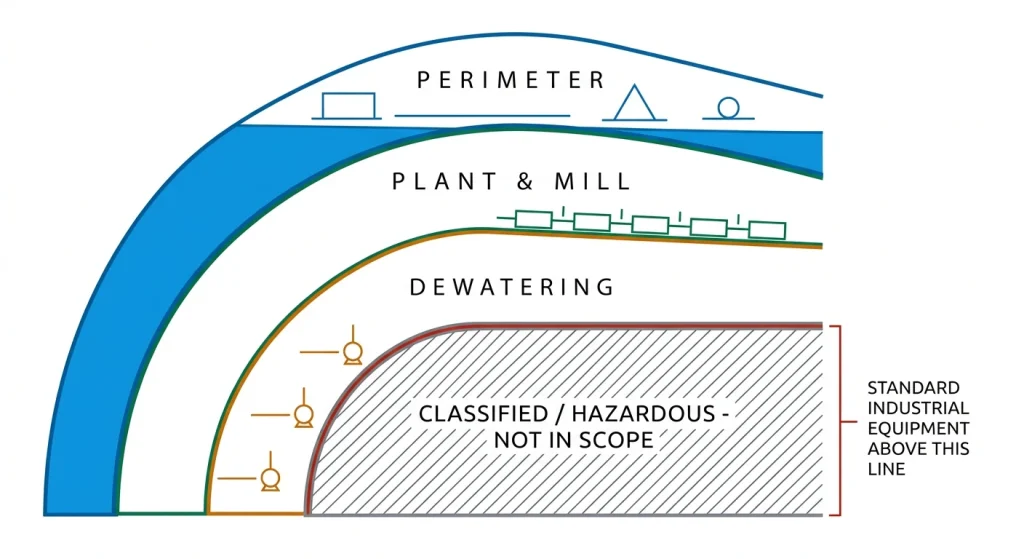
Safety boundary first. E-Lins industrial 4G/5G routers are not explosion-proof and carry no hazardous-area certification. They must not be installed underground in gassy zones, in classified hazardous areas, or anywhere a flammable atmosphere can be present. Those locations require certified explosion-proof equipment, installed under the site’s hazardous-area procedures. Everything in this guide applies above the classification boundary: the pit rim, the plant, the dewatering network, the tailings dam, the office and the gate.
Written by E-Lins Engineering Team
What “Smart Mining” Actually Involves Above Ground
Above the working face, a mine behaves like a harsh but conventional industrial site. It has four layers:
| The four above-ground layers of a mine site |
| —The pit rim. The primary crusher, the stockpile, the ROM pad, the survey network and the machine-guidance base stations that tell every loader and drill where it is. Exposed, moving as the pit widens. —The in-pit and dewatering layer. Sump pumps, settling ponds, rising mains, level and flow instrumentation. The least glamorous network on site and the one whose silent failure floods the pit. —The plant and mill. Fixed conveyors, screens, thickeners, flotation and the control room. A conventional process plant, speaking the conventional plant language: Modbus, discrete signals, a SCADA node that must not lose its link. —The perimeter. The tailings dam, the access road, the gate, the weighbridge, the monitoring wells. Widely spaced, often solar-powered, and the places where an unreported failure becomes a regulator’s problem. |
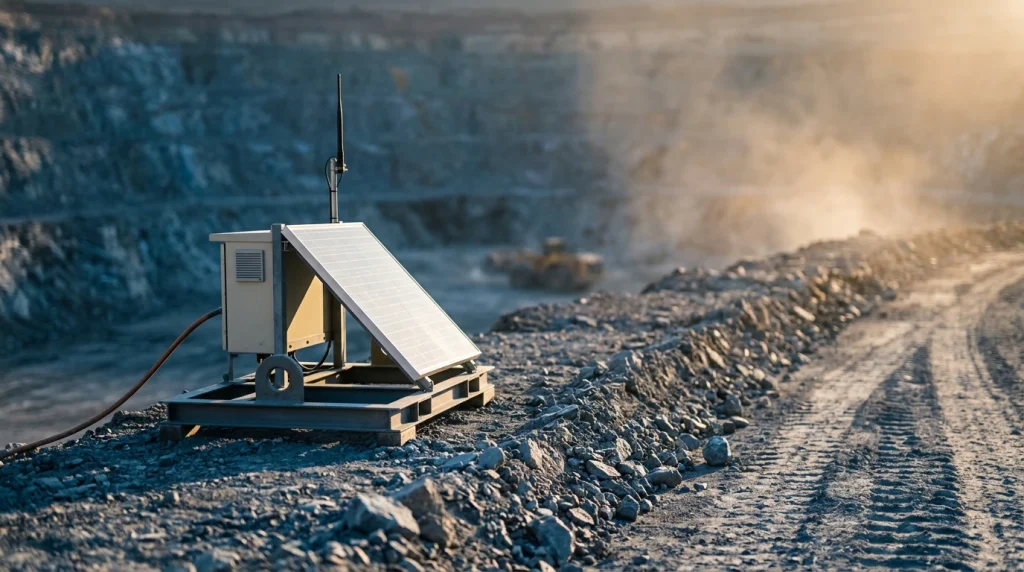
These are connected today mostly by fibre the pit will eventually cut, a licensed radio system that is already saturated, or nothing at all. Cellular is the fourth option. On a site that is cut back and rebuilt continuously, it has one decisive property over fibre: the antenna can be moved in an afternoon, and the cable does not have to be buried across a working bench.
| “We do not need the network to be permanent. We need to be able to pick it up on Friday and have it running on the new bench on Monday. Fibre cannot do that. A pole, a solar panel and a cellular router can.” |
| Mine-site network engineer, surface operations |
Dewatering: The Pump Network That Cannot Fail Silently
A pit is a hole below the water table, and the mine is in a permanent race against the water collecting in it. Sump pumps, rising mains and level controls run continuously. Their failure mode is not a dramatic alarm; it is a slow rise nobody notices until a bench is lost or a ramp is impassable.
What a dewatering station actually needs to report
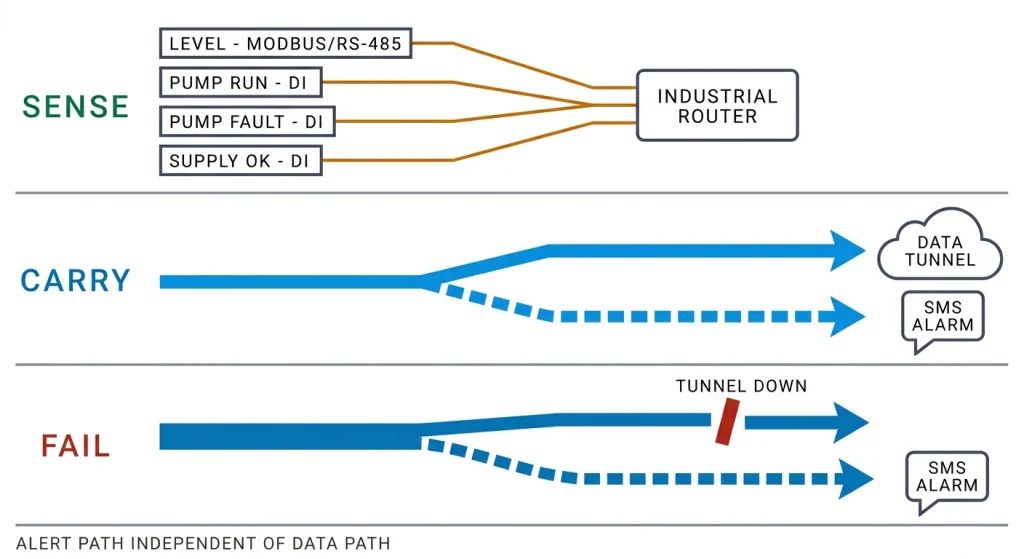
- Pump running / stopped / fault — a discrete state, and the single most useful fact on the site.
- Sump level — usually a level transmitter with a Modbus or analogue output.
- Pump current or power draw — the earliest sign of a pump running dry or cavitating, which no level reading shows.
- Station power health — whether the station still has a supply, which explains most “the site is quiet” investigations.
- A fault contact from the pump starter — the equipment’s own view of its condition.
Almost all of that maps onto what the range offers at the cabinet: DI/DO (Digital Input & Output) port * 4 for discrete states, a Serial Port RS232 or RS485 for a Modbus level transmitter or pump controller, and Modbus and DTU (serial to cellular) to carry that serial data over cellular. The H700 and H750 inputs are specified as 4 ports, 0-3.3V. Support status monitor via SMS and Email — logic-level sensing, readable remotely and by SMS.
| Design the alarm path separately from the data path. The range supports SMS/Voice Control and Alarm and SMS control, SMS gateway and SMS alarm. That matters here because an SMS alarm leaves the site over the signalling channel even when the data tunnel is down. A flood warning that only works while the data connection works is not a warning; it is a notification that conditions were good. |
With the optional switch-control board, a dewatering station also stops being read-only. It can close a contact — start a standby pump, release a valve — rather than merely reporting that someone should. On a mine, where the gap between “detected” and “a crew arrives” is measured in hours, that is worth designing for deliberately.
| “The pump that matters is the standby pump, and the reading that matters is whether anyone knows it started. If both of those leave the station on their own, the flooding problem is a log entry. If neither does, it is an incident.” |
| Pit dewatering engineer |
The Pit Rim Network: Survey, GNSS and Equipment That Moves
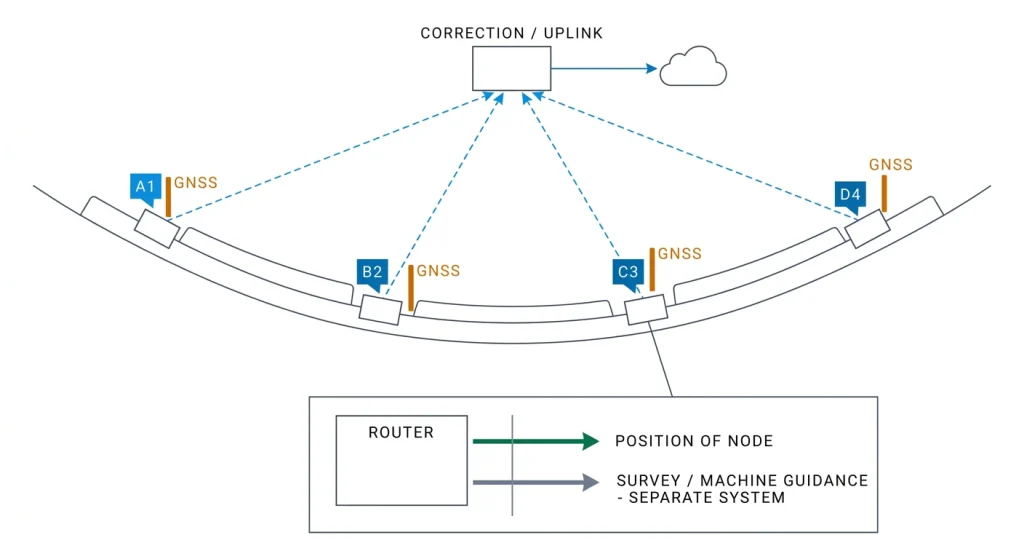
Drive to the edge of an operating pit and you will see a network most connectivity articles ignore: the survey and machine-guidance layer. Every drill, loader and haul truck is guided by positioning — GNSS corrected against a local base station — and the accuracy of that positioning decides whether the ore body is followed or missed. The base station and its correction link are production infrastructure sitting on a rim that keeps moving.
This is where a datasheet aside becomes central. Several models carry GPS/GNSS as an option — on the M300 and H685m modems specified as GPS/GNSS (Option) GPS, GNSS, Beidou — and the router range lists GPS / GNSS support with GPS antenna (SMA) * 1 on the H685, H700 and H750 families and a dedicated GPS antenna connector on the larger units. That onboard positioning is not a substitute for a survey-grade receiver; what it gives you is a network node that knows where it is.
| Why a position-aware network node is useful on a mine |
| —Asset tracking on a moving site. A router in a portable cabinet, lighting tower or pump skid reports where it has been moved to, so the network inventory follows the relocation instead of contradicting it. —Time and position correlation. Readings from a relocatable site are more useful when the record shows where the site was when it took them. —Relocation discipline. A fleet of nodes whose positions are known is a fleet you can audit after a bench cut, rather than hunt by radio signal. —Perimeter security. A cabinet that reports a position change has reported a theft or an unauthorised move. |
| Be precise about what this is. The GNSS option provides position for the network node; it is not a survey instrument and not a machine-control receiver, and no accuracy figure in the datasheet should be read as survey performance. Where the mine needs centimetre survey or machine guidance, that is a dedicated GNSS system whose correction data happens to travel over a link these routers can carry. Keep those two jobs separate and the specification stays honest. |
The connectivity job on the pit rim is then straightforward but unforgiving: the base station, the in-pit cameras, the lighting control and the instrumented equipment all need a link back to the plant over ground that has no cable and will not have cable. Note also that the larger units expose External antenna connectors for high gain antennas replacement — on a mine that is not a nicety. A high-gain directional antenna aimed downhill to the serving cell is often the difference between a marginal link and a working one, and connector access is what makes it possible.
Conveyors and the Plant: Modbus on a Moving Site
The plant and mill are where a mine becomes an ordinary — if hard-working — process site, and where the protocols are familiar ones. Fixed conveyors, screens, crushers, thickeners and the control room run on Modbus, discrete signalling and a SCADA layer.
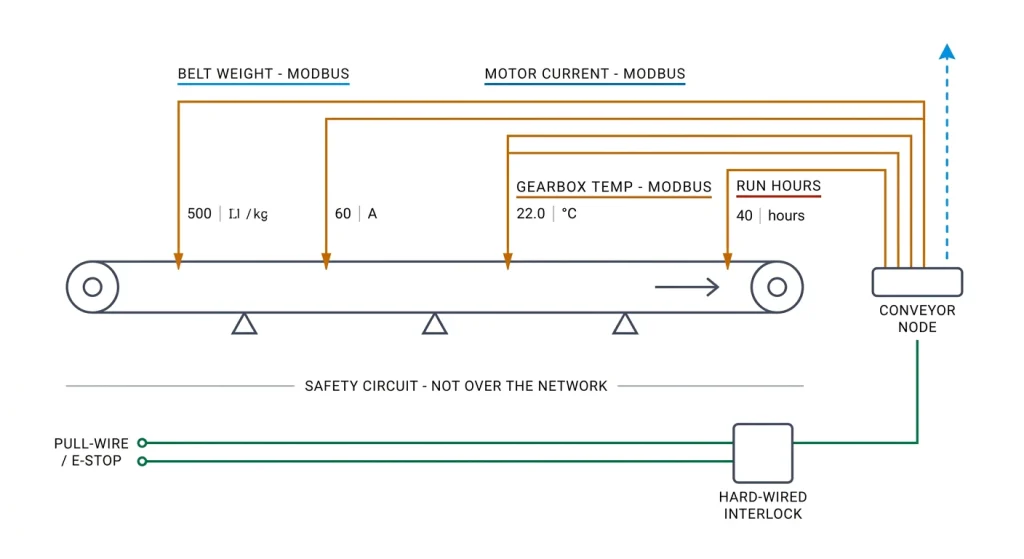
A conveyor shows why the router’s role is transport rather than control. A conveyor interlock is a safety function with hard-wired logic and its own certification; nobody should route a pull-wire stop through a cellular link. What does usefully travel over the network is everything else: belt weight and speed, motor current, gearbox temperature, run-hours, blockage and slip detection, and the fault sequence that explains why a shift under-produced.
| Conveyor and plant telemetry that suits a cellular router |
| —Modbus over serial. The range supports Modbus and DTU (serial to cellular) and Modbus is supported on the H700 and H750 families, so a belt scale, a drive or a protection relay on an RS-485 segment can be polled and transported. —Discrete run and fault states. DI/DO (Digital Input & Output) port * 4 per unit covers run, fault and local/remote selection without a dedicated PLC at every transfer point. —Ethernet where the plant already has it. From Megabit Ethernet LAN/WAN on the compact units to Gigabit Ethernet LAN/WAN 10/100/1000Mbps on the H700, H900 and H900f, so an existing segment can be extended rather than rebuilt. —Dust and vibration at the transfer points. The metal case is specified as ruggedized for vibration, shock, provide IP30 protection — relevant at a crusher discharge, where everything shakes. |
Two plant-specific notes belong in the design. First, a mine plant is a poisoned environment for wireless — steel structures, large rotating masses and a pit wall all play havoc with radio, so antenna placement and external antenna connectors for high gain antennas replacement matter more here than in a warehouse.
Second is PoE, and it is worth understanding in both directions. Several models offer POE PD or PSE. 802.3af and 802.3at, and the H900 and H900f extend that to POE PD or POE PSE … 802.3bt (POE++) with 48V1A/48V1.5A/48V2A (with POE PSE). As a PD the router can be fed by PoE, which simplifies a cabinet. As a PSE it can supply PoE to a camera or access point on the same drop — often the neatest way to instrument a transfer point with one cable and one box. Confirm the direction on your order code; “PoE” alone does not tell you which way the power flows.
Power at a Mine Site: The Input That Decides Everything
On a mine, power is rarely a clean 230 V socket in a climate-controlled room. It is a site distribution network built for draglines and mills, feeding your cabinet through a transformer, a long cable run and a relay, in a place where lightning is an ordinary seasonal event. The most common cause of an unreliable mine-site network is not radio coverage — it is an input power design that assumed a laboratory and met a mine.
The range is specified with a wide DC input precisely for this reason: 5-40V DC voltage input range (5-60V DC option), with Dual Power Inputs/Power Failover. A 24 V DC site bus, a 12 V battery and a 48 V PoE arrangement all fit within the range, and dual inputs mean the unit can survive the loss of one supply.
| From the datasheets — power input as specified |
| —Input range: 5-40V DC voltage input range (5-60V DC option), Dual Power Inputs/Power Failover —Fusing (from the installation guidance): For 9–24 VDC installations, use a 3 A fuse; For > 24 VDC installations, use a 2.5 A fuse; and for vehicle installations requires inline fuse —Protection: Built-in transient and reverse polarity voltage protection, over-current and over-voltage, with Reverse polarity and transient voltage protection per ISO 7637-2 —Lightning: the M300 and H685m modems are specified with anti-lightning protection —Idle and transmit draw: Idle: typical=100mA@12VDC; Maximum=500mA@12VDC on the router range, and Idle: 30mA@+9VDC on the M300/M400 modems |
Those two protections — transient and reverse-polarity, per ISO 7637-2 — are the ones I would point at first for a mine, because they describe exactly the failure a mine-site electrician will actually cause. Reverse polarity happens when a site cable is re-terminated in a hurry; transient voltage happens when a mill motor switches, a welder works nearby, or lightning couples into a long cable. A router that survives both does not turn a wiring mistake into a second truck trip.
| Size the power design against the reporting interval, not the peak. Idle draw is a fraction of transmit draw, so the energy budget of an off-grid site is dominated by how often the router transmits and how long it holds the radio up. On a mine, where much of the perimeter network is off-grid, that is a decision made once and lived with for years. |
One more note. A dewatering station or perimeter cabinet often sits on a supply that is itself monitored, and it is worth having the cabinet report its own power state as a discrete input. A site that reports “I am on battery” or “I have lost mains” explains most of its own outages before anyone drives out — and on a mine that drive is rarely short.
Surviving the Site: Dust, Vibration, Temperature, Lightning
A mine site attacks hardware in four ways at once, and each has a different answer in the datasheet. It is worth separating them, because “rugged” is a marketing word and the datasheet is not.
| Attack | Where it bites on a mine | What the datasheet specifies |
|---|---|---|
| Vibration & shock | Crusher discharge, conveyor transfer points, any cabinet bolted to a structure that shakes | Robust Metal Case is ruggedized for vibration, shock, provide IP30 protection |
| Temperature | Unshaded cabinets on the pit rim; inland mines with hot days and cold nights | All models: −35 °C to 75 °C ambient air operating; −40 °C to 85 °C storage |
| Humidity & condensation | Settling ponds, thickeners, the wet side of the plant | 5% to 95% operating and 5% to 95% storage, non-condensing |
| Electrical | Long cable runs, motor switching, seasonal lightning | transient and reverse polarity voltage protection per ISO 7637-2; anti-lightning protection on M300/H685m |
| Dust & water ingress | Everywhere on site; worst at the pit rim and the ROM pad | IP30 for cased units indoors or in a cabinet; IP68 for the H820QO outdoors |
The temperature figure is often read the wrong way. −35 °C to 75 °C is the ambient air operating range. A cabinet in full sun on the pit rim in summer is not at ambient — it is at ambient plus the greenhouse effect of its own enclosure, which can easily add twenty degrees or more. A router rated to 75 °C in a black steel box in the sun is being asked to operate at the top of its range, and the honest answer is a shade structure, a vented cabinet or a light-coloured enclosure. The rating is the ceiling, not the design condition.
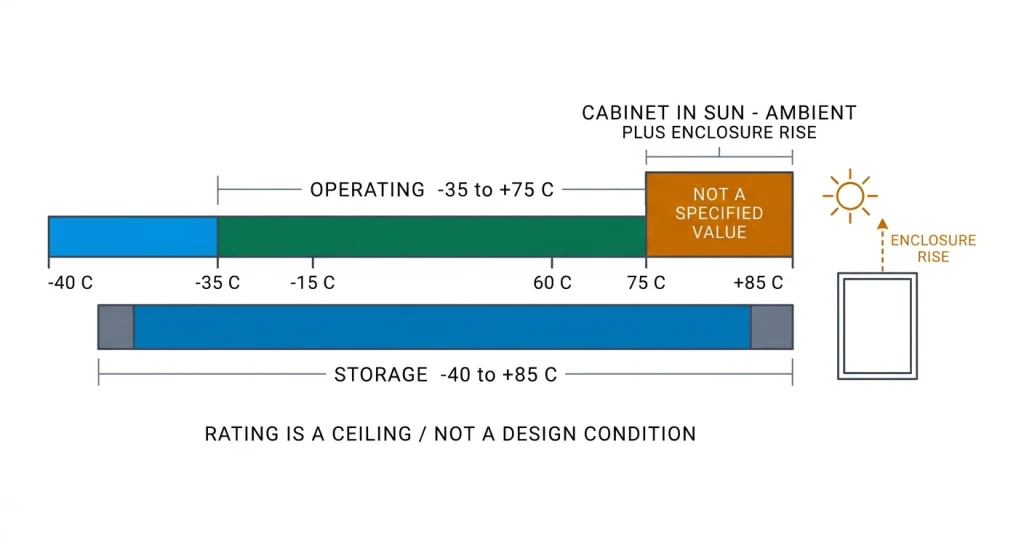
The four things to confirm before you commit a cabinet to the pit rim: (1) the actual enclosure you will put the router in and its thermal behaviour in sun and shade; (2) whether the location is inside a classified (hazardous) area, which decides whether any standard industrial router may be used at all — see section 03; (3) the ingress rating you actually need, remembering that on the outdoor unit it is the enclosure that is IP68, not a bare board; (4) the lightning exposure of the antenna and cable run. None of these is a router specification; all of them decide whether the router survives its first wet season. |
Dust Is a Dust Problem, Not an IP Rating Problem
This section exists because it is the most common mistake I see in mine-site specifications: treating an ingress rating as a licence to ignore the environment.
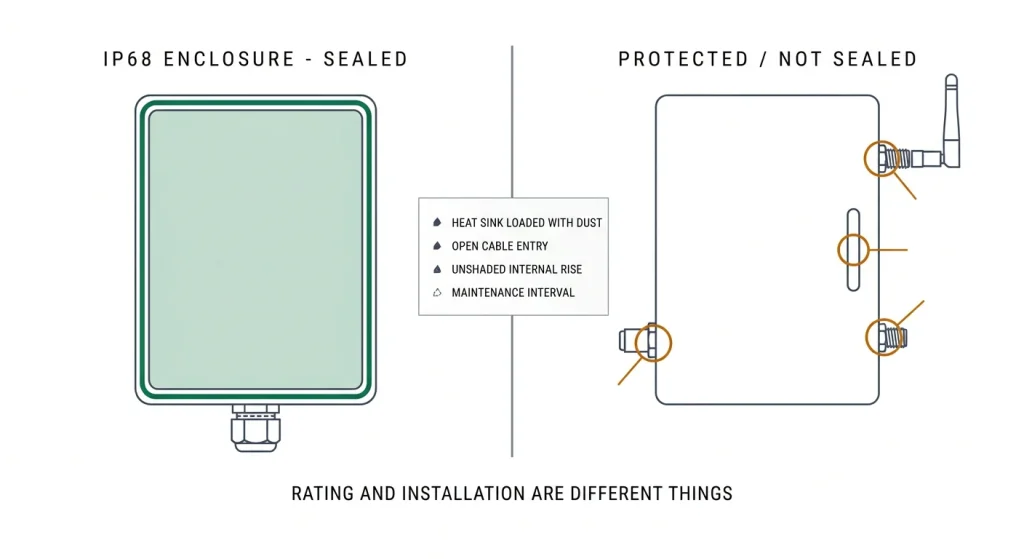
Mine dust is not house dust. It is fine, abrasive, conductive in the case of many sulphide and coal dusts, and it arrives in a quantity no exposed connector or fan-cooled enclosure tolerates for long without attention. A single IP68 rating — and only the H820QO carries that, as IP68 outdoor water proof and dust proof / IP68 grade anti-dust and anti-water enclosure for outdoor installation — tells you the enclosure resists dust and water ingress under the test conditions. It does not tell you that the antenna connector, the cable gland, the earth bond or the mounting bracket will.
What the IP68 rating does cover
- The sealed enclosure itself, against dust and water ingress
- Direct exposure of that enclosure on a pole or a wall
- The reason the H820QO is the right unit for the exposed pit rim, the dam and the flooded chamber
- A defined, testable level of protection — not an opinion about “outdoor”
What it does not cover
- Dust accumulating on a heat sink, changing the thermal picture
- An unprotected connector, gland or cable entry that is not part of the seal
- An unshaded cabinet whose internal temperature exceeds ambient
- The maintenance interval needed to keep any of the above true on a mine
The practical guidance is unglamorous: use the rated enclosure for the exposed location, put the cased units (specified as IP30) inside a dust-managed cabinet rather than in the open, seal the cable entries, and put “inspect and clean” on the maintenance schedule. In high-dust environments an IP30 unit in a well-sealed, shaded cabinet will outlast an IP68 unit left on a bracket with an exposed connector. The rating tells you what the box does; the installation decides what the site gets.
Keeping a Moving Fleet Managed Without Chasing It by Truck
A mine-site network is not one router. It is a dozen dewatering stations, half a dozen portable cabinets that move with the workface, the pit-rim base stations, the plant nodes and a scatter of perimeter sites — and the number grows as the pit does. Once the count passes the point where each site can be treated as a small project, the cost of one truck trip multiplied by the trips a site needs over its life will exceed the hardware inside it within a few years. That makes remote management a mine-network requirement, not an IT preference.
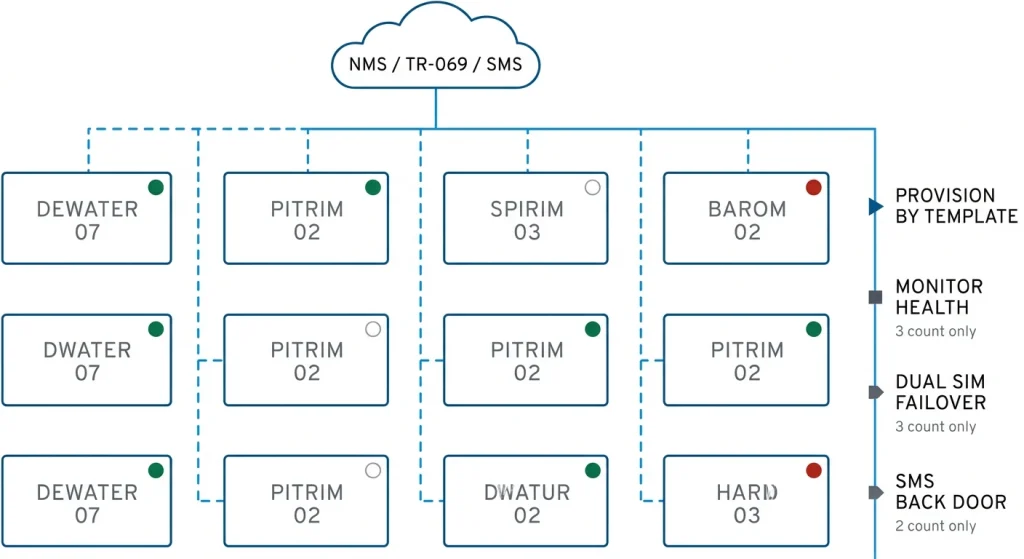
The range is cloud-managed through the E-Lins NMS, with TR-069, SNMP, web management, SSH/telnet/command and SMS among the management paths, and firmware updatable locally, remotely (LAN, Wi-Fi and OTA WAN) and NMS. On a relocatable site, OTA updates matter more than in a fixed plant: a site picked up and re-installed on a new bench should not need a technician just to reach the current software baseline.
| The fleet habits that matter on a mine |
| —Provision by template, not by hand. A site’s configuration — tunnel, polling, input rules, alert paths — should be a template with a few per-site variables, so a relocated or new site is a data entry rather than a build. Individually configured sites cannot be audited, because there is no baseline. —Monitor health, do not discover failure. Track the link, the signal, the supply state and the last-seen time for every site, so the dashboard tells you about a degraded station before a crew does. —Keep the SIM strategy deliberate. The range supports Multi-carrier 2G/3G/4G LTE support with Dual SIM card slot and a documented working-mode list — 1 Only SIM1 or SIM2, 2 time, 3 signal strength, 4 dial fail, 5 data limit, 6 ICMP check, 7 Load Balance, 8 Bonding (pending) — with Advanced Modem Failure Check and Dual SIM instant failover switching. On a remote site, a second SIM is the cheapest redundancy on the bill of materials. —Let SMS be an independent back door. SMS control, SMS gateway and SMS alarm let a site be rebooted, queried or alerted over a channel that does not depend on the data tunnel. That is the difference between managing a site and waiting for it. |
One discipline is buried in the fleet question and worth stating plainly: name and number sites by function, not by location. A station called “Pit 4 East sump” is misnamed within a season, when the sump moves and Pit 4 East is somewhere else. Call it “Dewatering Station 07” and keep its position as data — which, if the unit carries the GNSS option, it can report about itself. A network whose identity survives the move is a network you can still audit after the bench is cut.
What to Spec: Matching the Model to the Mine-Site Job
Eight models cover the above-ground mine-site network, differing in what matters at a site: port count, serial interface, PoE arrangement, positioning option and enclosure. The table is drawn from the datasheets; use it to narrow, then confirm the option set against your order code, because many of the features that decide whether a mine site works are options rather than standard.
| Model | Wireless / SIM | Ethernet & ports | Serial / I/O / GNSS | Power & environment | Best mine-site job |
|---|---|---|---|---|---|
| H685 | 4G LTE, single SIM; E-SIM and EUICC option | Megabit Ethernet LAN/WAN * 2; Wi-Fi, PoE PD options | Serial Port RS232 or RS485; DI/DO * 4; GPS antenna (SMA) * 1 | 5–40 V DC (5–60 V opt.); dual power inputs; −35…+75 °C; IP30 | The compact instrumented cabinet — a single conveyor node or a small pump station |
| H700 | 3G/4G LTE, dual SIM, 8 switch modes; dual-band Wi-Fi | Five LAN/WAN switchable 10/100/1000Mbps Gigabit Ethernet | Two serial (DB9 + terminal socket); DI/DO * 4, 0-3.3V; GPS SMA ×1 | 5–40 V DC (5–60 V opt.); dual power inputs; −35…+75 °C; IP30 | A plant or pit-rim hub: several Ethernet segments plus a serial bus and discrete states |
| H750 | 3G/4G LTE, dual SIM, 8 switch modes | Three LAN/WAN switchable 10/100Mbps Ethernet; POE (Power over Ethernet) | Serial connector – RS232/RS485 (Terminal Socket); DI/DO * 4, 0-3.3V; GPS SMA ×1 | 5–40 V DC (5–60 V opt.); dual power inputs; −35…+75 °C; IP30 | Modbus over RS-485 plus discrete I/O and dual SIM — the dewatering-station workhorse |
| H900f | 5G, dual SIM; dual/tri-band Wi-Fi | Gigabit + Megabit LAN/WAN; POE PD or POE PSE: 802.3af, 802.3at (POE+) and 802.3bt (POE++) | Serial Port RS232 or RS485; DI/DO * 4; GPS SMA ×1 | 5–40 V DC (5–60 V opt.); Idle: typical=120mA@12VDC; IP30 | Sites where 5G headroom is worth having — a future video or high-rate instrumentation need |
| H820QO | 4G LTE; single SIM standard, Dual SIM Optional; Built-in internal 14dbi antenna, external connectors reserved | Ethernet LAN/WAN * 2; POE PD | Modbus / DTU support; confirm I/O option; GPS antenna option | 5–40 V DC (5–60 V opt.); IP68; pole / wall mounting | The exposed location: the pit rim, the tailings dam, the flooded chamber, the fence line |
For a typical mine site the pattern falls out quickly. Instrumented cabinets and pump stations are served by the H750 or H700 — serial plus discrete I/O plus dual SIM — and the H900 family where more Ethernet and PoE output help. The exposed pit rim, the dam and the flooded chambers take the H820QO, because IP68 is the rating that matches the location. What the table does not settle is the option set, and on a mine the options are exactly where a design succeeds or fails.
| The five confirmations to make before ordering for a mine site. Ask E-Lins to confirm, against your order code: (1) whether the GPS/GNSS option is present, and on which models — it is an option, not a standard feature; (2) whether the serial interface is RS-232 or RS-485 and how unit addressing behaves in your intended mode; (3) the direction of PoE — PD, PSE or both — and the output figures, since “PoE” alone does not tell you which way power flows; (4) the operating temperature range and the ingress rating of the enclosure you will actually receive (IP30 for cased units, IP68 only on the H820QO); (5) the digital I/O configuration and its voltage level. Each is a commissioning failure waiting to happen if assumed rather than confirmed. |
Three Mine Patterns
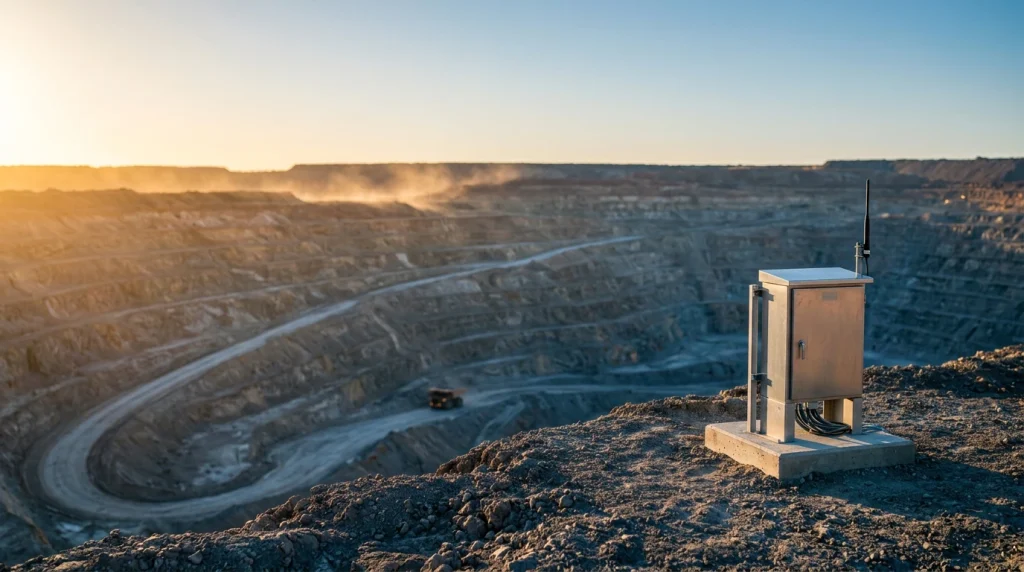
These are three shapes of mine-site network that recur, and the design lesson each one carries.
| Pattern 1 — The dewatering network |
| The job: keep a rising water table from taking a ramp, and know it is being kept. A dozen sump stations, each with a level transmitter on RS-485, one or two pump run/fault contacts, and a supply that may be a site feeder or a genset. |
| The design: an H750 or H700 per station — Modbus over serial for the level, DI/DO * 4 for the pump states and station supply, dual SIM for redundancy on a remote feeder, and an SMS alarm path configured so a pump fault leaves the site even if the data tunnel is down. Design the alarm as an SMS first and the dashboard second. |
| Pattern 2 — The relocatable workface site |
| The job: put connectivity on whatever bench is being worked this month, and move it next month without re-engineering it. Lighting control, an in-pit camera, a borehole monitor, a survey base station. |
| The design: build the site as a skid, not an installation — router, power, antenna and a fixed internal wiring loom, with one external connector for supply and one for the antenna. Use a unit that carries the GPS/GNSS option so the network knows where the skid is after it moves, and provision it from a template so relocation is a data entry. The discipline here is electrical, not radio: a portable site that is wired differently every time it lands is a portable site that fails somewhere new each time. |
| Pattern 3 — The exposed perimeter and the dam |
| The job: monitor a tailings dam, a rising main, a borehole field or an access gate, in locations that are far apart, often off-grid, and directly exposed to weather and dust. |
| The design: the H820QO where the hardware is genuinely outdoors and must be IP68; a solar or battery supply sized against the reporting interval rather than the peak, remembering Idle: typical=100mA@12VDC; and an SMS path for the genuinely urgent events — a dam instrument, a rising main pressure loss, a gate breach — so the alert does not depend on the data link. At a tailings dam the failure you cannot accept is the silent one. |
The common thread is not a product. On all three patterns the decisions that decide success are the alarm path, the power budget, the enclosure and the option set — and the router is the component that makes those decisions physically possible rather than the one that makes them for you.
Frequently Asked Questions
Q1:Are E-Lins routers explosion-proof or certified for hazardous areas?
No. E-Lins industrial routers are not explosion-proof and carry no hazardous-area certification. They are general-purpose industrial routers for ordinary industrial environments and must not be installed in an underground gassy zone, a classified hazardous area, or anywhere a flammable atmosphere can occur. Those locations require equipment certified explosion-proof for the specific zone, gas group and temperature class, installed under the site’s hazardous-area procedures. On a mine, apply these routers only above the classification boundary.
Q2:Does an E-Lins router support mine-survey or machine-guidance accuracy?
No. Several models carry a GPS/GNSS option — on the M300 and H685m modems specified as GPS/GNSS (Option) GPS, GNSS, Beidou — which provides position for the network node, not survey-grade measurement. It is useful for tracking a relocatable site, correlating readings with where they were taken, and detecting an unauthorised move. Centimetre survey and machine guidance are separate, dedicated GNSS systems, whose correction data may travel over a link these routers carry.
Q3:Can I read a pit sump level or a pump current directly on the router?
Partly. The routers read digital inputs and speak serial protocols; the H700/H750 digital inputs are specified as 4 ports, 0-3.3V. Support status monitor via SMS and Email — logic-level sensing, not analogue measurement. A level transmitter should be read over Modbus and DTU (serial to cellular) on the serial port, or via an I/O module on the bus. Pump run and fault states and the station’s own supply state fit the four digital inputs well; a 4–20 mA loop or a raw current reading needs a converter or a Modbus-capable device first.
Q4:Will the site still report a dewatering alarm if the cellular data connection fails?
Yes, if you design it that way. The range supports SMS control, SMS gateway and SMS alarm and SMS/Voice Control and Alarm — SMS or call to bring a router online or offline, reboot it, and read signal and status. An SMS alarm travels over the signalling channel without needing the data tunnel to be up, which is exactly what a dewatering station or a tailings dam needs. Configure and test it from a real site with the data connection disabled; an alert that only works while the data path works is not an alert.
Q5:What power supply do I need for an off-grid mine perimeter site?
The range specifies 5-40V DC voltage input range (5-60V DC option), Dual Power Inputs/Power Failover, which covers a 12 V or 24 V solar/battery bus and tolerates a battery under charge and discharge. Idle consumption on the router range is typical=100mA@12VDC with Maximum=500mA@12VDC, and the M300/M400 modems are specified at Idle: 30mA@+9VDC. Size the panel and battery against the reporting interval you intend to run, not the one you hope to run. The datasheets specify a 3 A fuse for 9–24 VDC installations and a 2.5 A fuse for > 24 VDC.
| Conclusion: Design the Network for the Move |
| A mine-site network is not judged by how well it performs on the day it is commissioned. It is judged in year three, when the pit outline has changed, the sump has moved, the bench it was built on is gone and the question is whether anyone still knows what the network is doing and where it is. |
| Three things to settle before you specify connectivity for a mine: —Draw the classification boundary first. Decide, with the site’s electrical authority, exactly where the hazardous area begins. Everything above that line is a standard industrial connectivity problem; everything below it belongs to certified explosion-proof equipment, and no E-Lins router is offered for it. Getting this boundary on the drawing before you choose hardware prevents the one mistake on this list that is a safety issue rather than a cost issue. —Separate what is tied to ground from what is tied to the workface. Fixed plant, the office and the dam are built once. Dewatering, survey, lighting and in-pit instrumentation are built to move, and they should be specified, named and provisioned as relocatable infrastructure — skids and templates, not installations. —Treat the alarm path, the power budget and the enclosure as design decisions, not accessories. An SMS alarm that leaves the site when the data tunnel is down, a power design sized against the reporting interval, and the correct ingress rating for the actual location are what keep a mine-site network honest. The router makes them possible; it does not make them for you. |
Building a Smart Mining Network Above the Explosion Zone?
Tell E-Lins your site layers, the jobs each site has to do, your power sources and your exposure conditions. We’ll confirm the serial and digital I/O configuration, the GNSS option, the PoE direction, the temperature and ingress rating, and the right platform — H685, H700, H750, H900f, H820QO — for the network you actually operate. For hazardous areas, we will say plainly that the equipment is not ours to supply.


