
When a 5G modem resumes from a low-power state, a working host is only the first sign of recovery. The gateway must also rediscover the PCIe endpoint when required, restore the driver interface, and complete a fresh application transaction.
The exact recovery path depends on the modem, host controller, board power design and BSP. This test plan follows that path from the host to the application, making it easier to identify where recovery stops and which engineering team has the evidence needed to investigate it.
Define sleep, reset and resume states
Two test runs can end with the same gateway back in service yet exercise very different recovery paths. In one, the host resumes while the modem remains powered. In another, a reset or power transition makes the endpoint disappear and then return. Treating those runs as equivalent can hide the failure the test is meant to expose.
It helps to separate three conditions that are often loosely described as “sleep.” A PCIe link state such as L0 or L1 describes the connection between the host and endpoint; it does not tell you whether the gateway has entered system sleep or whether the modem has lost power. Device states such as D0, D3hot and D3cold describe the modem’s own power condition. In D3hot, PCI configuration space remains accessible. In D3cold, the platform has removed the device’s supply voltage (Vcc), so returning to D0 requires power restoration and a full power-on reset sequence. Host suspend/resume, host restart, modem reset and complete power interruption are separate system events, each with its own expected recovery path.
If the modem is expected to wake the host, the wake path has another dependency: the modem must support PME from the intended power state, and the host platform must be able to route and handle that event. Keep modem-initiated wake separate from host-initiated resume when defining the test cases.
Once those boundaries are clear, build the run list around the transitions the finished gateway is actually expected to use. The following matrix is a starting point; unsupported states should be excluded rather than treated as mandatory tests.
| Test scenario | Expected behavior | Evidence to capture |
|---|---|---|
| PCIe link low-power transition | The link returns to its expected active state without unintended endpoint loss. | Link-state and controller logs. |
| Host-initiated system suspend and resume | The host completes the transition and the modem returns to the expected device state. | System power-management events and PCIe discovery records. |
| Modem-initiated PME wake, if supported | The platform receives the wake event, resumes the host and restores the expected device state. | PME capability, wake-source records and platform resume events. |
| D3hot transition, if supported | The device returns to D0 and the required driver interface becomes operational. | Device power-state and driver logs. |
| D3cold transition, if supported | Device power is restored, followed by the required power-on reset and enumeration sequence. | Power-control events, reset timing and device-discovery records. |
| Controlled modem reset | The device completes the documented reset and reinitialization sequence; endpoint visibility follows the specified reset type. | Reset events and device-discovery records. |
| Full power interruption | The modem completes its documented power-on initialization and becomes usable by the host. | Power-rail observations, boot events and application results. |
An unattended monitoring gateway illustrates why these distinctions matter. It may suspend between measurement windows, restart during planned maintenance, or experience a complete power interruption. Each event creates a different recovery expectation, even if the dashboard shows the same symptom when reporting stops.
For every selected scenario, record the starting device condition, the trigger, which components remain powered, whether endpoint disappearance is expected and what counts as recovery. Tie the result to the board revision, host processor and PCIe controller, firmware and BSP builds, driver version and exact modem variant. That baseline is what makes a passing run reproducible on another gateway.
At the hardware review stage, E-Lins’ industrial 5G modems category provides a commercial starting point for discussing an embedded project. It is not evidence that a listed finished modem exposes the PCIe interface required by this test. The available form factor, electrical interface, and supported resume states must be checked separately before selecting a candidate.
Observe host and modem sequencing
A host can finish waking while the expected modem remains absent from the PCIe bus. A different failure can leave the PCIe function visible but the driver unusable. Both may appear to an operator as “no connection,” although they belong to different engineering owners and need different evidence.
Start from a known working state, trigger the approved transition and follow recovery outward. The host should complete its system transition first; the expected PCIe endpoint should then reappear when the event requires rediscovery; the driver should bind and initialize; and the application should complete a fresh transaction. The first checkpoint that fails is usually more useful than the final error reported by the application.
The host/BSP team should capture its suspend and resume events together with available root-complex and enumeration records. Device identity is a better comparison point than assuming a particular bus address can never change. The driver owner then checks whether the expected binding occurred and the necessary device-facing interface was restored.
Some approved reset paths legitimately make the endpoint disappear before it returns. That temporary absence is not automatically a failure. A persistent missing endpoint after the required checkpoint is different, especially if recovery needs an intervention that the installation cannot perform remotely.
Record the interval from a defined trigger to each observed checkpoint, but do not impose a universal wake-time threshold. A deployment-specific limit needs to be agreed by the OEM and supported by the actual hardware and software design. Repeated trials should use the same transition and logging conditions so intermittent failures can be separated from unrelated configuration changes.
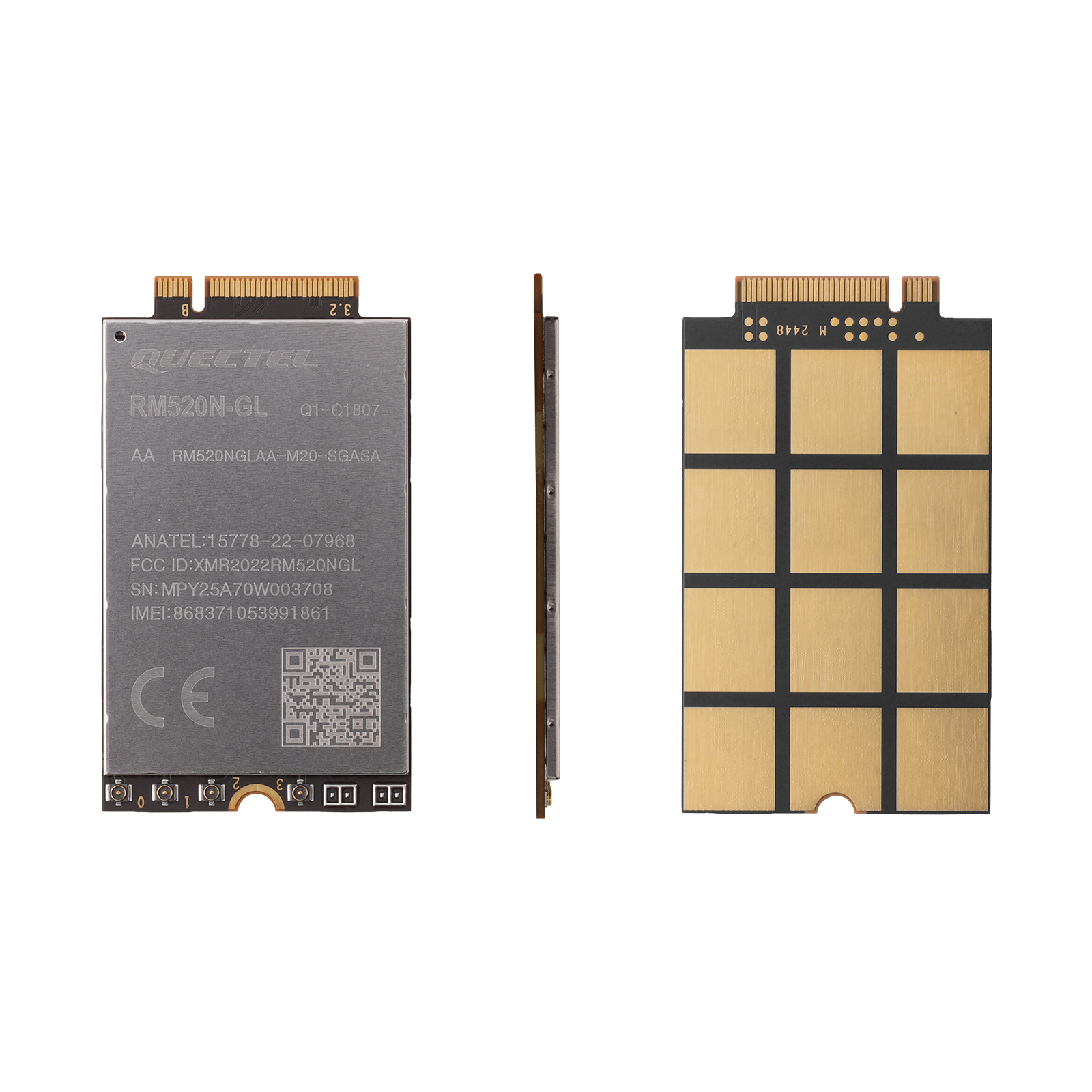
RM520N-GL: confirm the host-side PCIe path
The E-Lins store lists the RM520N-GL as a 5G M.2 radio module with a PCIe 3.0 interface. That makes it relevant to an OEM discussion about endpoint discovery and driver integration—not proof of any particular power-state transition.
Validate reconnection and application ownership
Enumeration answers only whether the host can find the expected PCIe function. It does not prove that the gateway has resumed its work. A process may still hold a handle or session created before suspend; after the interface returns, that state may no longer be valid. The application therefore needs a defined way to preserve, reopen or recreate its resources. A modem should not be credited with restoring a software session it does not manage.
Responsibility follows the same recovery path. The modem supplier documents endpoint behavior and supported operating conditions; the host and BSP team own platform transitions, PCIe discovery, reset coordination and driver readiness; the application team proves that a fresh workload operation succeeds. Field operations define the approved local or remote recovery procedure if automatic recovery stops short of usable service.
A meaningful service check must go beyond a running-process indicator or a historical “connected” flag. For the monitoring example, the application might generate a new record and obtain the expected acknowledgement. A command-driven gateway would need a different transaction. The test should follow the real workload, without expanding this PCIe-resume article into general cellular network-registration troubleshooting.
For an unattended installation, application behavior and field access are connected decisions. If an apparently recovered device still requires a person to restart a process, the acceptance record must make that dependence visible. Whether it is permissible depends on the project’s operational requirement—not on the modem name alone.
Record failure signatures
“Modem offline after sleep” is not a useful handoff diagnosis. If the host wakes but the endpoint is missing, preserve the controller events, enumeration output and reset observations for the platform team; endpoint absence alone does not prove a modem fault.
If the endpoint is present but the driver is not ready, record its identity, binding messages and initialization errors so the host–driver path can be compared with the working baseline. If the driver is ready but service remains unavailable, look at the application’s resource lifecycle and require a fresh workload transaction rather than relying on a running-process indicator.
When automatic recovery stops and local intervention is required, record the exact action, the state beforehand and the evidence still available remotely. A later power cycle may restore service, but it does not prove that the original resume path passed.
Where feasible, align log timestamps across the operating system, driver, application, and external test controller. If clock sources differ, use explicit event markers to reconstruct the sequence. Physical state observations may require board-level instrumentation planned before the run; software logs should not be treated as a substitute for measurements they cannot provide.
Retries deserve separate treatment. If an automatic retry hides the initial failure, record both the failed attempt and the later recovery. Repeating resets before collecting the first error may turn a reproducible engineering problem into an unhelpful “could not reproduce” note.
For projects built around a PCIe 2.0 host path, the E-Lins-listed RM500U-EA 5G M.2 module provides another integration reference. Its published specifications list PCIe 2.0 ×1 and a Linux PCIe driver. Those details help establish the interface and software prerequisites, but they do not confirm suspend/resume behavior on a particular host. Validate the exact module variant and BSP combination before including it in the test matrix.
Set acceptance criteria
Acceptance is not a claim that a modem supports every PCIe state. It is an agreement that the selected gateway configuration recovers from the specific events required in deployment. One OEM may require unattended recovery after every approved suspend cycle but allow supervised intervention after a maintenance reset; another may prohibit local intervention altogether.
The acceptance criteria should reflect that operating model, with recovery time measured between clearly defined start and completion events.
For each test, define what counts as a completed host transition, whether the endpoint should be visible, when the driver is considered ready and which fresh application operation proves that service has returned. The evidence should follow those same checkpoints: platform logs for the host transition, enumeration records for the endpoint, binding and initialization logs for the driver, and a new workload result for the application. If field intervention is allowed, record the approved recovery action and who is responsible for it.
Keep every result tied to the board revision, modem variant, firmware and driver builds, test event, trial count, measured checkpoint times and supporting evidence. Record failed attempts separately; a later passing run does not erase an earlier failure or establish an acceptable failure rate.
A configuration is ready for release when the agreed recovery behavior has been demonstrated and another engineer can review the evidence. Unsupported states and unresolved intervention requirements should remain explicit release limitations.
Related reading
Before validating resume behavior, confirm that the modem and host board use a compatible electrical interface. This guide covers M.2 and mPCIe integration; this article focuses on PCIe power-state and service-recovery validation.
Confirm interface and product form before assuming a board is a PCIe modem endpoint.
Frequently Asked Questions
How should PCIe link states be separated from system sleep states?
Log the link, PCI device, and host system conditions independently. Link power management does not prove system sleep, and a successful host wake does not prove that the endpoint returned. Test only transitions supported by the specific platform and modem.
What if the host resumes but the modem is not enumerated?
Verify the intended host transition, preserve root-complex and enumeration records, and review the approved device reset sequence. Escalate to the platform and BSP owner before attributing the missing endpoint to the modem or application.
Which checks confirm application service recovery after wake?
Verify the required driver-facing interface, the application’s restored communication state, and one fresh operation completed against the gateway’s actual workload. Device visibility and a running process are not sufficient by themselves.
Discuss Your 5G Modem Integration Requirements
Choosing a suitable 5G modem involves more than confirming its PCIe interface. The host board, power-control design, firmware, driver support and required recovery behavior must work together. Share your board revision, host interface, BSP configuration and intended power-state transitions with E-Lins to discuss the hardware requirements for your embedded gateway project.
For background on PCI device states and system-level power management, see the Linux kernel PCI power management documentation. This reference does not establish product-specific compatibility.


