
Excavation damage is one of the leading causes of serious pipeline incidents, it is almost entirely preventable, and it is almost impossible to see — a backhoe on your right-of-way looks, from every control room, exactly like an empty field. The sensing hardware to catch it already exists: geophone sentinels, distributed acoustic sensing over the fibre you may already own, cameras. What has never been reliable is the network that carries their verdict out of the field. This is a field guide to the connectivity layer of pipeline right-of-way protection — where an industrial cellular router with digital I/O, an independent SMS alarm and an honest edge-AI boundary turn “there is a dig-in somewhere along 80 km” into an alert, a location and a camera frame, before anyone reaches the line.
Written by E-Lins Engineering Team
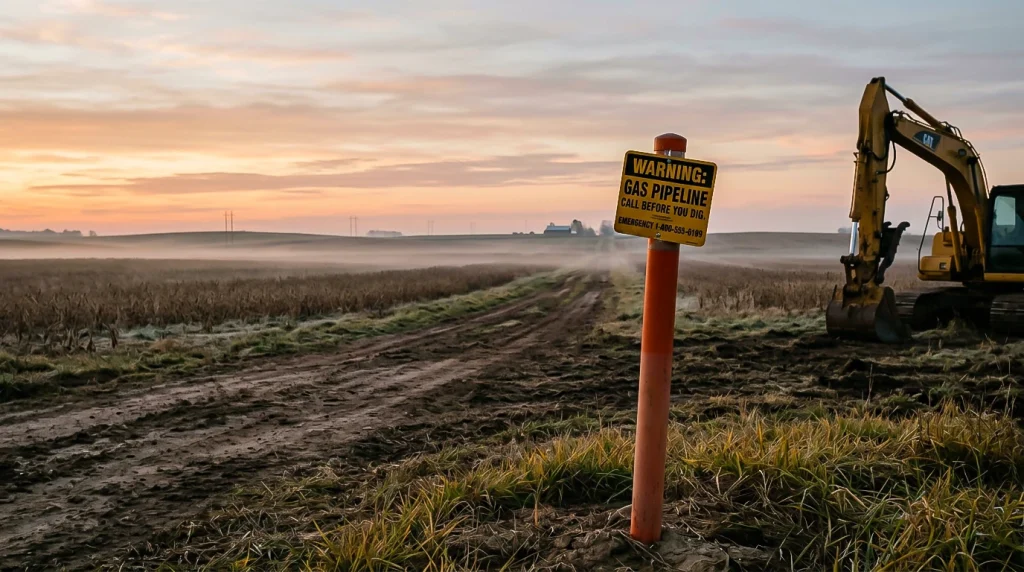
The Invisible Threat on an Empty Right-of-Way
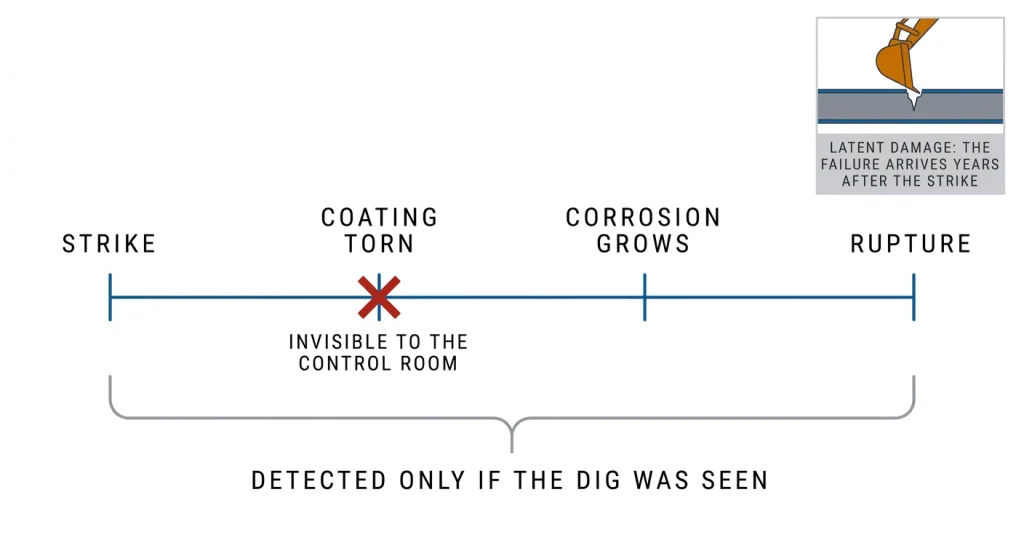
Third-party excavation remains a major pipeline integrity risk. An excavator working near a buried line may cause damage without triggering an immediate leak, leaving a damaged coating or gouged pipe that can lead to failure years later.
Traditional patrols and periodic inspections cannot continuously monitor every kilometre of a pipeline right-of-way. The gap between inspections creates an opportunity for unauthorised excavation to go unnoticed until the damage becomes more serious.
Effective protection depends on more than detecting ground disturbance. It requires turning a sensor event into a timely, location-aware alert that reaches the people responsible for pipeline safety.
| The reframe. Right-of-way protection is not a camera problem and not a fence problem. It is a detection-to-decision latency problem. The value of the whole system is set by how long a ground disturbance takes to become a verified alert with a location attached. Everything below serves shrinking that number. |
This article is about the layer that shrinks it — the network behind the sensors. The sensors themselves — geophone sentinels, DAS, cameras — are largely solved technology and are not what E-Lins makes. What E-Lins makes is the field connectivity node that turns a scatter of remote sensing hardware into a system a control room can act on, and that keeps working over a solar site with no mains and no one to visit it.
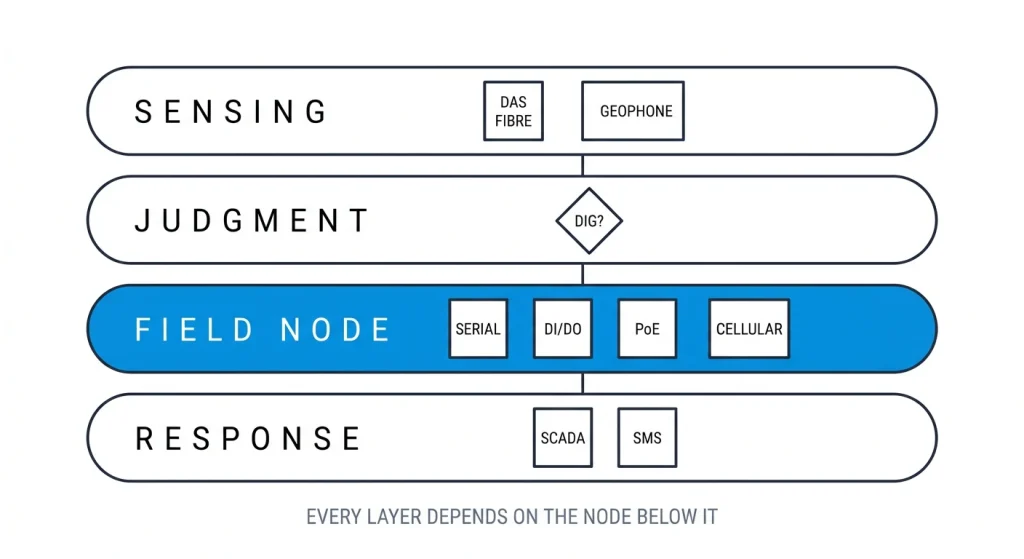
Anatomy of a Right-of-Way Watch
A pipeline ROW monitoring system works through four connected layers:
1. The sensing layer
Detect ground disturbance using distributed acoustic sensing (DAS), point sensors or cameras.
2. The judgment layer
Filter signals and identify events that may indicate excavation or other threats.
3. The field node
Connect sensors and legacy equipment through an industrial router, using interfaces such as RS232, RS485, Ethernet or digital I/O.
4. The response path
Send event data to the control room over cellular or other available links, with SMS as an alternative alert path where supported.
| Layer | What it produces | What it asks of the network | Typical failure if the network is weak |
|---|---|---|---|
| Sensing (DAS / sentinel / acoustic) | Time-stamped event + rough location | Reliable backhaul of many small events; optional raw capture for tuning | Events dropped silently; blind corridor |
| Judgment (rules / edge / platform) | Classified event: dig / vehicle / noise | Low latency to move a decision in time to act | Alarm arrives after the excavator has left |
| Field node (router + I/O) | Bridged serial, DI/DO state, camera feed, uplink | Serial + digital I/O + PoE + cellular in one box | Separate boxes, separate failures, no single owner |
| Response path | An alert a human can act on | An out-of-band escape when the data path is down | Silence — the worst outcome of all |
The industrial router serves as the connectivity hub between field equipment and remote monitoring systems. It does not replace specialised sensing or AI platforms; it helps ensure that useful data and alarms can reach the people who need to act.
The Detection Layers and What Each One Costs the Link
Not every detection technology asks the same thing of the network, and conflating them is how a right-of-way project ends up with a data plan three times the size of the fleet it serves. There are three families, and they differ enormously in what crosses the cellular link.
Distributed acoustic sensing — event-rich at the source
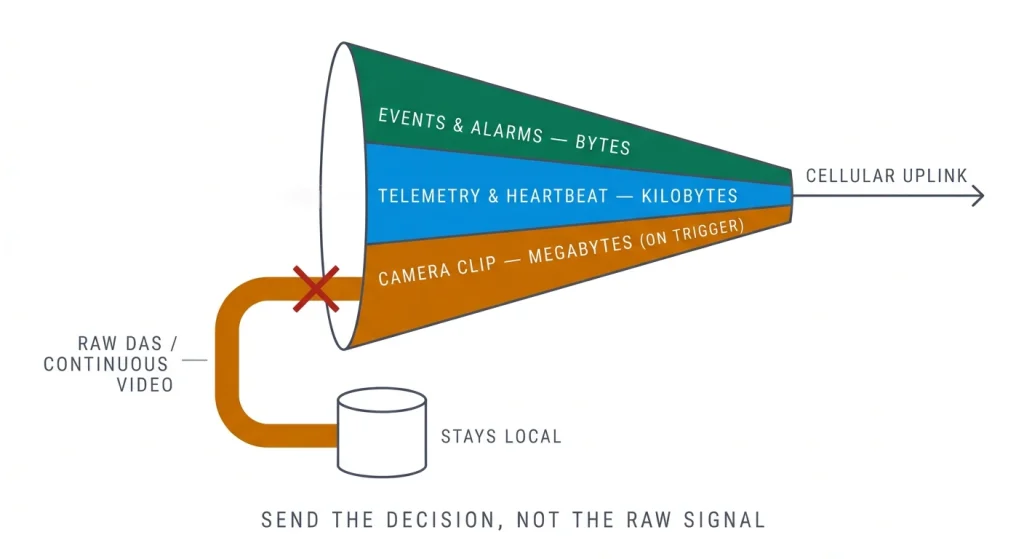
A DAS interrogator watches tens of kilometres of fibre and produces a continuous stream. The honest engineering point is that you do not send that raw stream anywhere. It is processed at or near the interrogator, and what crosses the network is the event: a classified signature with a position along the fibre. Used well, DAS is a small-data application sitting on top of a large local computation.
Point sentinels — sparse, low-rate, high-value
A geophone sentinel at a road crossing or construction-prone marker is the opposite profile. It is idle most of the time, wakes on a ground-wave event, classifies it locally, and reports a compact result with a GPS fix. Its data appetite is kilobytes per event. What it needs from the network is not bandwidth but availability: it must get that one event out, on the day that matters, from a place with weak coverage and no mains.
Cameras — the verification layer, not the detection layer
Cameras answer “is the alert real and what is happening.” A PTZ or fixed camera at a high-risk point, triggered by the sensing layer, gives a dispatcher a picture before they send anyone. The trap is streaming. Continuous video is the fastest way to exhaust a metered cellular plan, and a right-of-way camera does not need to stream continuously — it needs to deliver a clip or a frame when an event fires.
This is why the selective uplink is the design centre of a good right-of-way network. Three tiers of traffic — alarms (bytes), scheduled telemetry (kilobytes), and bulk verification video (megabytes, on demand) — cross a single metered link, and the node’s job is to enforce that policy rather than be a pipe a camera can flood.
The Field Node: The Unglamorous Center of the System
By now the pattern is clear: every layer above produces a verdict, every layer below consumes one. What sits between them, in a steel cabinet on a pole beside a pipe, is the device that has to work. This is where right-of-way projects are won and lost — not on the sensing technology, which the buyer has usually already chosen, but on whether the box that ties it together has the ports, the I/O and the survival rating the site demands.
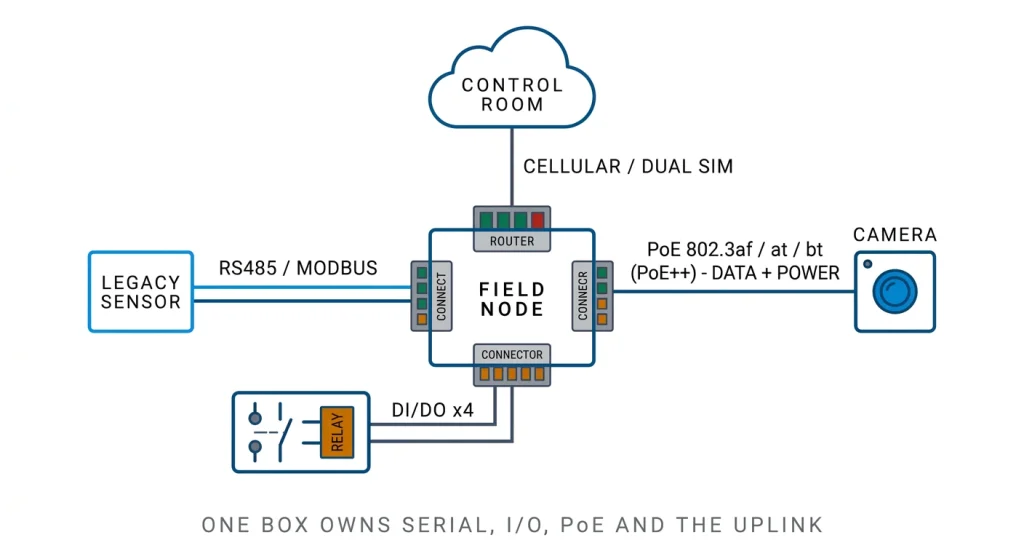
An E-Lins field node brings four capabilities together in one ruggedized unit, each mapping to a distinct job on a right-of-way site.
Serial reach: RS232 / RS485 with Modbus and DTU
Half the equipment you will inherit on a pipeline speaks serial, not IP: legacy monitoring units, the odd 4-20 mA loop with a serial interface, the incumbent RTU that predates the re-route. None will be replaced to satisfy a network diagram. E-Lins routers carry RS232/RS485 with Modbus and DTU (serial-to-cellular) support, so the node can poll registers or pass serial data transparently across the cellular link. The old equipment keeps working; the office gains visibility it never had.
Digital I/O: reading the physical world directly
Not every signal is worth a protocol. A cabinet door, a tamper contact, a pressure switch, a relay that must be driven on command — these are the raw digital facts of a field site. E-Lins nodes provide DI/DO ×4 (digital input and output ports): the node can read a dry contact and, on command, close a relay. On a right-of-way that is the toolkit for an intrusion contact on the cabinet, a siren to deter an excavator in the moment, or an interlock that must act without a round trip to a control room.
The Ethernet and PoE port: one cable to a camera
The verification camera needs data and power at the far end of a pole, where running a mains feed is often the most expensive part of the install. E-Lins nodes offer PoE PD or PSE options across 802.3af / 802.3at / 802.3bt (PoE, PoE+, PoE++), so one Cat cable carries both. For an outdoor camera with a winter heater the relevant class is 802.3bt (PoE++) — a camera drawing 12 W in summer can pull several times that with its heater running, and the budget must be sized for the cold case.
The uplink: cellular, with a failover story
Finally the node has to get out. Cellular is the default for the right-of-way because running fibre to a sensor beside a pipe in a field is rarely economic. E-Lins nodes support dual SIM with failover/failback, multi-WAN failover and load balance across cellular, WAN RJ45 and Wi-Fi-as-WAN, and an advanced modem failure check with watchdog — the redundancy set that turns a single weak carrier into a link a farm crossing and a river valley cannot silently take down.
| One box, one owner. The temptation on a right-of-way project is to buy the sensing from one vendor, the camera from another, and a small industrial switch from a third — and then discover that on the day the alert fires, no single component owns the path end to end. A single field node carrying serial, digital I/O, PoE and the uplink in one enclosure with one management plane is the difference between a system and a pile of parts. |
The Alarm That Has to Escape
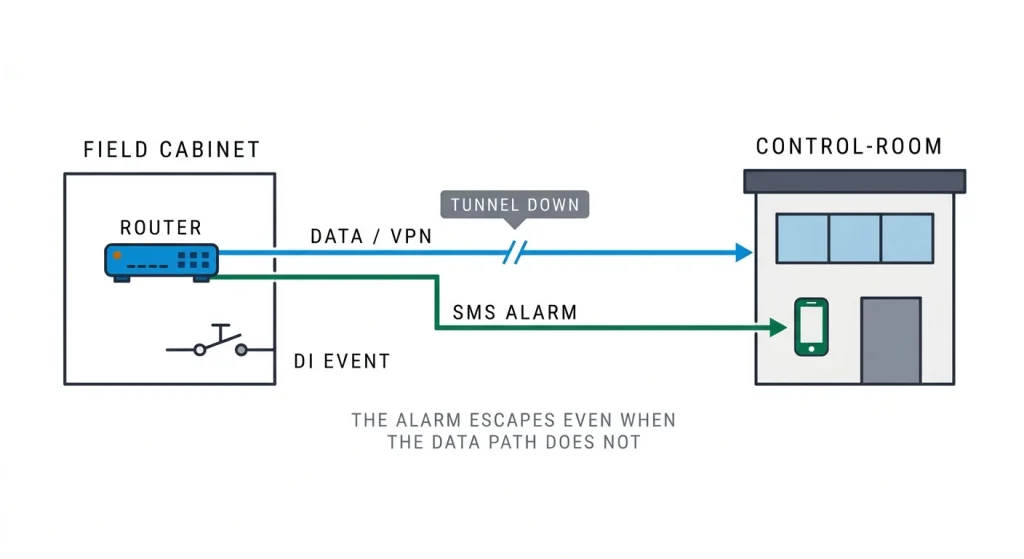
Here is the failure right-of-way projects are worst at designing for, and the one that matters most. The event the whole system exists to catch — a dig-in — can arrive at the worst possible moment for the network: the excavator may have nicked a buried service, the solar site may be at the end of a long dark winter, the carrier may pick that hour to have a bad one. If the alarm depends on the same data tunnel that just degraded, the system fails silently at the exact moment it was built for.
The fix is old and unglamorous: an out-of-band alarm path. E-Lins nodes support SMS control, SMS gateway and SMS alarm, and can read a digital input and send an SMS on that event independently of the data tunnel. When the primary data path is down but the cellular module still has a signal, the SMS still leaves the field. When the data tunnel is up, the SMS is a belt to the platform alarm’s braces.
| Signal | Primary path | Out-of-band path | Why both |
|---|---|---|---|
| Classified dig event | Platform alarm over the VPN | SMS alarm on DI / event trigger | Data path can be degraded exactly when the event fires |
| Cabinet door / tamper | DI state in NMS | Immediate SMS on contact | Physical intrusion is a real-time physical event |
| Power loss / low battery | Voltage telemetry | SMS on threshold | Lets you reach the site before the battery dies |
| Node reboot / link down | Watchdog + NMS | SMS status reply on demand | Confirms whether the node is alive without a visit |
The same channel runs the other direction. A field node can be queried and controlled by SMS or voice — brought online, taken offline, rebooted, asked for its signal and status. On a site two hours from the nearest technician, texting the node for a status reply or a reboot is the difference between a same-day fix and a next-week one.
| Design the alarm path as if the data path is already down, because on the day it matters it may be. Treat the out-of-band path as a first-class requirement, not a checkbox. |
No Mains, No Building: Power and Enclosure in the Field
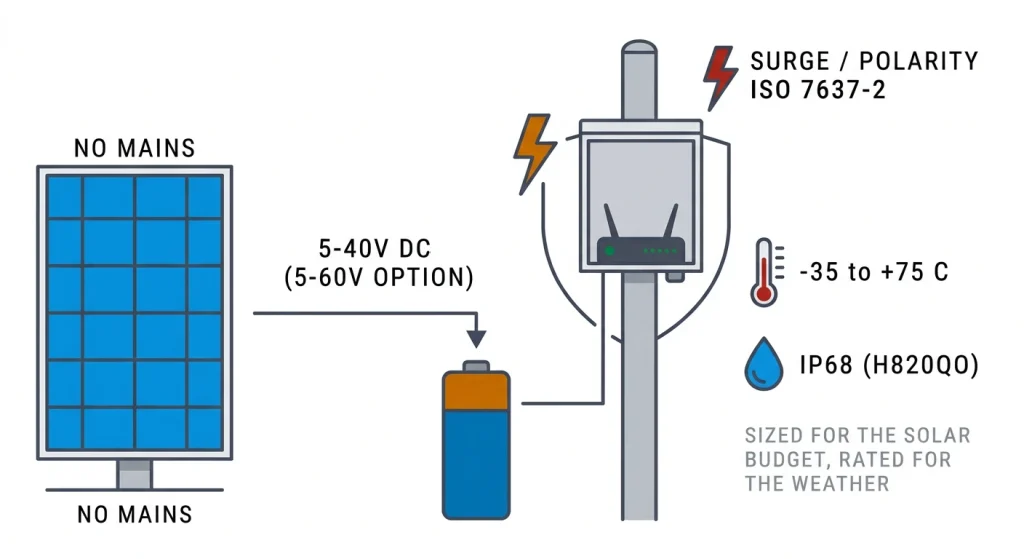
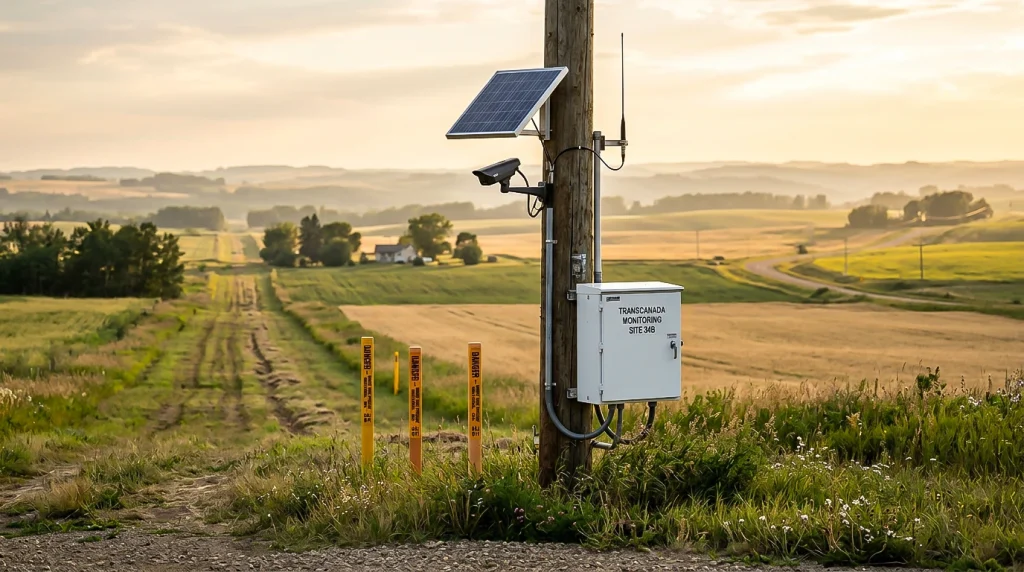
A right-of-way site is not a control room: no 230 V socket, no air conditioning, no plant room, no one within walking distance. The node lives in a cabinet on a pole or pad, fed from a solar array and battery through a charge controller and a long cable, where a lightning strike is an ordinary seasonal event. Power design and enclosure are more of an engineering decision than the router model is — and they decide whether the sensing above survives its first wet season.
Wide input, dual power, surge survival
E-Lins nodes accept a 5-40V DC input (5-60V DC option) with dual power inputs and power failover, plus built-in transient and reverse-polarity protection, over-current and over-voltage protection, and surge/polarity protection per ISO 7637-2. On a solar site that wide range is not a spec-sheet nicety: it lets the node ride a battery voltage that swings with state of charge and temperature, and lets a second supply take over without a reboot.
The power budget is set by the reporting interval
On a solar site, average consumption — not peak — decides the panel and battery size. A node idling near 100 mA @ 12VDC, asleep except to send a heartbeat and listen for an event, draws a fraction of one holding a continuous VPN. Send events, not streams — the architecture choice is also the power choice.
Temperature and ingress
Field cabinets swing from summer heat to hard winter frost. E-Lins platforms operate across −35 °C to +75 °C ambient (−40 °C to +85 °C storage). Inside a case, the metal-cased models carry IP30 protection; where the node itself must live outdoors on the pole, the H820QO is a genuinely outdoor platform rated IP68 for water and dust.
| DC input 5-40V DC (5-60V option) Power failover Dual inputs Surge / polarity ISO 7637-2 Idle current ~100 mA @ 12VDC Operating temp. −35…+75 °C Ingress (cased) IP30 Ingress (outdoor) IP68 (H820QO) Mount Pole / wall / DIN-rail |
None of this is exotic — it is the ordinary discipline of putting network hardware where it does not belong. On a right-of-way it is the difference between a system that survives to its fifth winter and one described, in the incident report, as “found offline at the time of the event.”
Edge Judgment: Classify in the Field, Don’t Stream It
The detection section left a promise: raw vibration is not an alert, and something must decide whether a ground disturbance is a backhoe or a tractor. That decision — classification — is where the term “edge AI” attaches to pipeline projects, and where it is most often oversold. So let us be exact about what an E-Lins field node does and does not do.
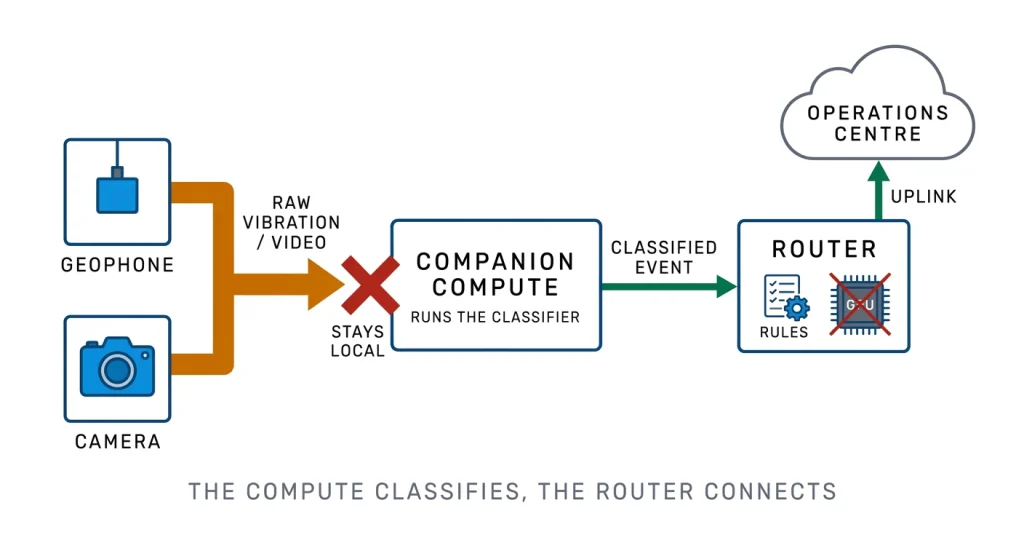
E-Lins industrial routers are built around efficient networking-class CPUs. They are not GPU or NPU inference engines, and none of the platforms in this article includes a dedicated AI accelerator. A genuine machine-learning classifier — one that separates a bucket strike from a passing truck with useful accuracy — runs on a companion edge compute device, and it should. The router’s job is to give that device a rugged, always-on network, to secure the model-update and event paths, and to carry the small decision upstream. It is a pairing, not a substitution, and shipping raw video or vibration to a data centre breaks both the budget and the response time.
That said, much useful judgment needs no GPU at all, and it belongs on the node. A field node can run rules, thresholds and scripting: a digital input that must not chatter, a temperature or pressure value that crosses a limit, a state that is only interesting when it persists. These are the filters that keep a false alarm from becoming a truck roll, and they are what a networking-class CPU is good at.
On the router (no accelerator needed)
- Threshold and limit rules
- DI/DO state logic and debounce
- Heartbeat and health watchdogs
- SMS on a defined DI event
- VLAN/QoS policy for the uplink
On the companion compute device
- Vibration signature classification
- Video analytics / object detection
- Multi-sensor fusion and scoring
- Model training feedback loops
- Raw-capture ring buffer for tuning
The payoff of keeping the judgment in the field is a network profile you can budget: the compute device emits a decision (bytes), the router carries it upstream, and the raw signal never leaves the segment. It also keeps the alert fast, because a round trip to a distant cloud is no longer in the critical path of a decision that may need to fire a local siren before the excavator finishes its pass.
| The honest boundary. “Edge AI on the router” is a marketing phrase that describes a rules engine with a flattering name. The real architecture is a router paired with a companion compute device: the compute classifies, the router connects and protects, and only the verdict travels. Spec it that way and the system will do what the brochure promised. |
Securing the Alarm Path
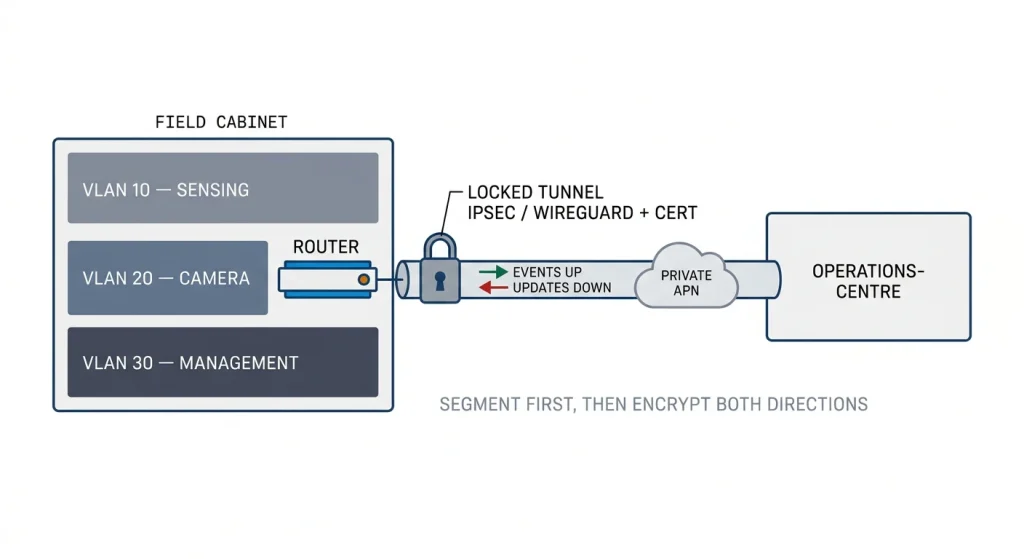
A right-of-way network is a security target with an unusual profile. Its most sensitive traffic is not customer data; it is the event stream and the location data behind it — precisely the information an adversary would want to suppress. Someone who intends to tap a line has a real interest in whether the sensors above it report what they see. A network that can be silently blinded is worse than no network, because it produces false confidence. The controls are the ordinary hardening controls, applied to an exposed estate, and they start with segmentation.
Segment first: VLANs
An exposed cabinet should not be one flat network. E-Lins nodes support VLAN 802.1Q, so the OT serial leg, the camera and the management plane each sit in their own segment. If a camera is compromised, it has no path to the sensing and control side — on a right-of-way, where a pole-mounted node may host a physically reachable camera, this is not optional hygiene.
Encrypt the path: VPN with certificates
The event stream and the model-update path both cross a hostile public network. E-Lins platforms support IPsec, OpenVPN, GRE, DMVPN and WireGuard (options), with certificate support, and can run over a private APN so the traffic never touches the public internet. Site-to-site tunnels with NHRP let a whole corridor of sites reach the operations centre over one manageable topology.
Authenticate the access
Remote management of a hundred field nodes is itself an attack surface. E-Lins nodes support 802.1x authentication for Ethernet, optional RADIUS or TACACS+, certificate-based access, and a zone-based object firewall with host, port and MAC rules — so a management path is a known path, governed by policy rather than who still has the password.
| Control | E-Lins capability | What it protects on a right-of-way |
|---|---|---|
| Network segmentation | VLAN 802.1Q | Keeps a compromised camera away from the sensing/control leg |
| Tunnel encryption | IPsec / OpenVPN / GRE / DMVPN / WireGuard | Keeps the event stream and model updates off the public internet |
| Private network | Private APN support | A corridor that is not reachable from the open internet |
| Access authentication | 802.1x, RADIUS / TACACS+, certificates | Management only by the identities you intend |
| Policy firewall | Zone-based object firewall | No inbound path that the design did not open deliberately |
| A blind right-of-way is a false floor. Segmentation, certificate-based tunnels and authenticated management keep the event stream trustworthy. A node that reports “all clear” because someone turned it off is worse than a node that reports nothing at all. |
Coverage Along a Line
A pipeline crosses every terrain and every coverage quality there is. A site in a river valley, a crossing in a cut where the signal disappears, a stretch where one carrier is strong and the other is not — the network must be designed for the worst point on the line.
Dual SIM and carrier diversity
E-Lins nodes support dual SIM with failover/failback and, on flagship platforms, dual-module dual-SIM (two SIMs online), with SIM-based auto-carrier selection and optional eSIM / EUICC. On a corridor, the practical win is carrier diversity: where two operators both cover a site, a node that can fail over between them removes the single-carrier outage that would otherwise be a blind spot.
Multi-WAN and Wi-Fi-as-WAN
At stations and terminals where a wired uplink exists, the node can fail over and load-balance across cellular, WAN RJ45 and Wi-Fi-as-WAN, so the cellular path becomes a backup rather than the only option.
GNSS and antenna reality
And “where” matters as much as “what”: a GPS/GNSS (Beidou) option attaches a fix to the event, removing the guesswork from dispatch. None of it helps if the antenna cannot hear, so E-Lins nodes provide external high-gain antenna connectors and MIMO — letting an installer aim for a weak-carrier valley rather than accepting the internal antenna’s verdict.
| SIM Dual SIM failover (dual-module option) eSIM E-SIM / EUICC (option) Multi-WAN Cell / WAN RJ45 / Wi-Fi GNSS GPS / Beidou (option) Antenna External SMA, high-gain, MIMO Failover Failover + failback Watchdog Modem failure check |
The Long Fleet: Hundreds of Nodes Over a Thousand Kilometres
One node is a site. A right-of-way is a fleet — a few hundred sentinels, camera poles, station gateways and monitoring skids spread across a corridor that may run a thousand kilometres. Nothing scales worse at that distance than configuration drift and firmware you cannot see, and nothing fails more quietly than a node that dropped off months ago and no one noticed because it had never raised an alarm.
Manageability is therefore not an administrative nicety on a pipeline; it is a detection-layer control in its own right. A system that cannot tell you which nodes are online is, by definition, partially blind — and its blind spots are exactly where an incident will eventually occur.
Zero-touch provisioning
A field node should arrive configured-by-policy, not configured-by-hand. With centralized provisioning, a node pulled from stock and powered on at a new or replacement site receives its configuration, credentials and firmware profile automatically — no engineer on site. For an operation that extends a line, this is the difference between a rollout that reaches the far end of the corridor and one that stalls at the first hard-to-reach crossing.
Centralized NMS with TR-069 and SNMP
E-Lins supports centralized management via NMS with TR-069 and SNMP integration — the layer that turns a scattered estate into a fleet you can name. From a desk, an operator sees which nodes are online, which SIM is active, signal strength, and whether firmware and credentials are current. Bulk firmware push and credential rotation become fleet actions rather than a hundred separate site visits.
| Fleet capability | What it replaces | Why it matters on a right-of-way |
|---|---|---|
| Zero-touch provisioning | Manual on-site setup per node | Extending a corridor without an engineer at every crossing |
| Centralized NMS (TR-069 / SNMP) | Spreadsheets and tribal knowledge | One view of status, SIM, signal and config across hundreds of nodes |
| Bulk firmware / config push | Driving to each cabinet | Patch a vulnerability or fix a setting across the whole line at once |
| Remote diagnostics & logs | Guesswork from a failed alarm | See why a node went silent before sending anyone out |
| Credential / certificate rotation | Per-site manual key changes | Keeps tunnel security current as staff and contractors change |
| Manageability is a detection control. A node that is offline is a hole in your right-of-way watch, and a hole that lasts months is a false sense of coverage. The fleet view is not paperwork — it is the map of where you are not watching. |
What to Spec: Matching the E-Lins Industrial Cellular Router to the Site
The right-of-way question is rarely “which model” in isolation; it is “which model for which site, and which options must be ticked so it works when it reaches the corridor.” The table below maps the E-Lins platforms suited to right-of-way duties to the jobs this article has defined — a fit guide, not a full datasheet.
| Model | Radio & SIM | Serial / I/O | Power & PoE | Best right-of-way role |
|---|---|---|---|---|
| H900f | 5G (SA+NSA), dual SIM (dual-module option), tri-band Wi-Fi, Gigabit ETH | RS232/RS485, DI/DO ×4 | PoE PD or PSE 802.3af/at/bt (PoE++) | The full segment node: serial sensor bridge + PoE++ camera pole + 5G uplink |
| H685f | 5G, Gigabit ETH ×2, Wi-Fi | RS232/RS485, DI/DO ×4 | PoE PD 802.3af/at/bt (PoE++) | Compact 5G node, including embed-style installs; serial reach + PoE++ power |
| H685frc | 5G RedCap (cost-optimized), Gigabit ETH | RS232/RS485, DI/DO ×4 | PoE PD 802.3af/at/bt (PoE++) | Cost-sensitive segments that still want 5G-era efficiency; sentinel + light camera |
| H820QO | 4G, dual SIM, outdoor | Serial, Modbus/DTU | PoE PD (per input; see datasheet) | Genuinely outdoor pole / field enclosure; IP68 water & dust, wide temperature |
| H700 | Dual SIM 4G, Gigabit ETH, dual Wi-Fi | RS232/RS485, DI/DO ×4 | Dual power inputs, failover | Sentinel & telemetry hub: Modbus polling, DI/DO alarms, dual-SIM resilience |
| H750 | Dual SIM 4G | RS232/RS485; DI/DO ×4 | Dual power inputs / failover | Entry serial-bridge / contact reporting node where cost is the primary constraint |
Figures are indicative and drawn from each model’s published E-Lins datasheet at time of writing; optional features, PoE roles and power budgets vary by configuration and must be confirmed for the specific site. None of these platforms includes a dedicated GPU/NPU AI accelerator — pair with a purpose-built edge compute device for genuine ML classification of vibration or video.
In short: need PoE++ for a camera pole and serial for an inherited sensor on one segment — H900f or H685f, with H685frc as the cost-optimized 5G path. A pole-mounted outdoor node with no shelter — the IP68 H820QO. Contact reporting and serial bridging with no camera — H700 or H750 with dual SIM. Every platform carries RS232/RS485 and DI/DO ×4, so pick radio, PoE direction and ruggedness by the site.
Frequently Asked Questions
Q1:Can one E-Lins node really tie a vibration sentinel, a camera and a legacy sensor together?
Yes — that is precisely the job it is built for. A node carries RS232/RS485 with Modbus/DTU for the legacy serial device, DI/DO ×4 for a contact or a driven relay, an Ethernet/PoE port for a camera over a single Cat cable (up to 802.3bt / PoE++), and a cellular uplink with dual-SIM failover. Choosing one box for all four means that on the day an alert fires, one device owns the path end to end instead of three vendors pointing at each other.
Q2:Does an E-Lins router run the vibration or video classifier itself?
No — not genuine machine learning. E-Lins routers are built around efficient networking-class CPUs, not GPU or NPU accelerators, and none of the platforms in this article includes a dedicated AI accelerator. Real classification of vibration or video runs on a companion edge compute device, which the router gives a rugged, always-on, secured network. Simple rules, thresholds, DI/DO logic and SMS-on-event run on the router’s own rules layer and need no accelerator at all.
Q3:What happens to the alarm when the data tunnel is down?
It still leaves the site, if the alarm path was designed as out-of-band. E-Lins nodes support SMS control, SMS gateway and SMS alarm, and can read a digital input and send an SMS on that event independently of the data tunnel. When the primary path is degraded but the cellular module still has a signal, the SMS still goes out. The same channel lets you query or command the node — online, offline, reboot, status — by SMS when the management platform cannot see it.
Q4:How do I stop a verification camera from exhausting the cellular data plan?
By policy, not by luck. Design a three-tier uplink: classified events and alarms (bytes) cross freely; scheduled telemetry and heartbeats cross on a schedule; camera clips and bulk transfers are reserved for the rare occasions an event has fired. The node enforces the policy with VLAN/QoS shaping and local staging, and the camera is triggered by the sensing layer rather than streaming continuously — on a right-of-way, continuous video is the fastest way to overspend a metered plan for a picture nobody is watching.
Q5:How do I keep a few hundred exposed field nodes secure?
Layer the controls and centralize them. Segment first with VLANs so a compromised camera has no path to the sensing and control leg; encrypt with certificate-based VPN tunnels (IPsec, OpenVPN, WireGuard, DMVPN) ideally over a private APN; authenticate access with 802.1x, RADIUS/TACACS+ and a zone-based firewall; and harden physically with wide-temperature, wide-input hardware and, where the node is pole-mounted outdoors, IP68 equipment like the H820QO. Run it all through centralized NMS with TR-069 and SNMP so patching and credential rotation are fleet actions.
Q6:What redundancy do I need for a corridor with patchy coverage and solar power?
Layered redundancy. Dual SIM with failover/failback (two carriers, or a physical SIM plus eSIM/EUICC where supported) removes single-carrier outages; multi-WAN failover across cellular, WAN RJ45 and Wi-Fi-as-WAN covers a site with a wired option; a modem failure check and watchdog recovers a hung radio without a site visit; a wide 5-40V (5-60V option) dual-input supply rides a solar battery’s voltage swing; and an SMS alarm on a DI event is an out-of-band escape.
| Conclusion: Shrink the Time From Dig to Decision |
| A right-of-way network is not judged by the sensing technology on the drawing. It is judged on the day a contractor’s bucket touches the ground above the line — how fast the disturbance became a classified alert, how fast that alert carried a location, and whether the path that carried it survived the same moment the event did. Three things to settle before you specify connectivity: |
| —Design the alarm path as if the data path is already down. The event that matters most is also the one most likely to coincide with the link it depends on being degraded. An out-of-band SMS on a digital input, and the ability to query and command the node by SMS, keep the system honest at the worst possible hour. —Decide where judgment lives, and be honest about it. Rules and thresholds belong on the router; genuine classifiers belong on a companion compute device the router connects and protects. Keep the raw signal in the field and send the verdict, and both the data budget and the response time come right. —Treat power, enclosure and manageability as design decisions, not accessories. A wide-input dual supply sized against the reporting interval, the correct ingress rating for a pole that is genuinely outdoors, and a fleet view that shows which nodes are actually online — these keep a thousand-kilometre corridor from quietly developing holes. |
Building Right-of-Way Integrity Into a Pipeline?
Tell E-Lins your site types, the sensing hardware you have chosen, your power sources and your exposure conditions. We’ll confirm the serial and digital I/O configuration, the PoE direction, the GNSS option, the temperature and ingress rating, and the right platform — H685f, H685frc, H700, H750, H820QO or H900f — for the corridor you actually operate.


